
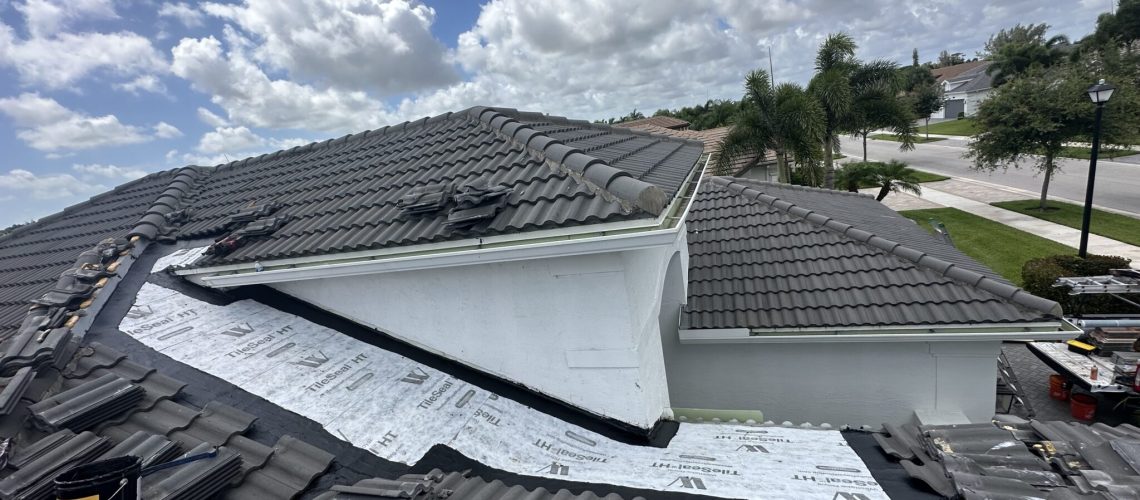
On a tile roof, the tile is the part you see. What keeps water out is underneath it: the underlayment, the valley metal, the flashing and the seals around every pipe and vent. That is where storm leaks usually start, and it is exactly what a pre-storm inspection has to reach.
- Concrete and clay roof tiles can last 50 years or longer with proper installation and maintenance. The components beneath and between them are what usually fail first.
- A visual-only inspection can’t tell you the condition of the underlayment. Tiles have to be lifted.
- When the failure is localized, a targeted rebuild opens only the failed sections and reinstalls your existing tile.
- Photo documentation of your roof’s condition may be useful when an insurer reviews an older roof.
Why tile roofs leak in a storm
Tile sheds water off its surface and into the valleys. The underlayment beneath it is the waterproofing layer. When wind-driven rain gets past the tile, whether through a cracked tile, a lifted edge or a worn valley, the underlayment and flashing are what stand between that water and your roof deck. The usual entry points:
- Aged or torn underlayment. Once it cracks or tears, wind-driven rain has a direct path to the deck.
- Cracked or slipped tiles. Even a few expose the underlayment to direct water.
- Worn valley metal. Valleys carry the most water in a heavy rain, and corroded or poorly lapped valley metal is a frequent leak source.
- Failed flashing and seals at pipe boots, vents, chimneys and skylights.
- Loose ridge and hip caps and cracked mortar at vents.
- Debris in the valleys that backs water up under the tile edges.
What a pre-storm inspection should cover
A meaningful inspection looks at the whole roof system, not just the surface.
Tile condition and fastening
Every cracked, slipped or loose tile is a potential entry point. Individual tiles can usually be replaced and matched without touching the rest of the roof.
Underlayment
This is the step quick inspections skip, because it means carefully lifting tiles to see the membrane directly. Brittleness, tears or moisture staining tell you it is no longer doing its job.
A visual-only inspection cannot assess underlayment condition. If a contractor doesn’t lift tiles and look, they can’t tell you whether it is failing.
Valleys, flashing and penetrations
Valleys should be clear of debris and free of corrosion, gaps or improper laps. Flashing and seals around every pipe, vent and piece of equipment should be intact.
Ridge caps, fascia and drip edge
Loose ridge caps, cracked mortar and damaged fascia or drip edge let water into the roof at its edges and peaks, which is where storm wind pushes hardest.
Our free roof inspections cover all of this and include attic thermal imaging, with a written summary and photos.
A tile roof that looks fine from the street can still have failed underlayment. The only way to know is to lift the tile and look.
When the inspection finds a failure
Finding failed underlayment or a worn valley does not automatically mean a new roof. When inspection shows the failure is localized, a targeted roof rebuild addresses it directly: we open the failed sections, replace the underlayment and flashing there, repair any damaged decking and reinstall your existing tile.
| Full Roof Replacement | Targeted Roof Rebuild | |
|---|---|---|
| Scope | Tear off and replace the entire system | Rebuild only the failed sections |
| Best when | The roof system as a whole has reached the end of its useful life | Inspection shows the failure is localized |
| Existing tile | Removed and replaced | Sound tile removed, stored and reinstalled |
| Fastening | New system to current code | Rebuilt sections fastened to current requirements |
For tile roofs specifically, see our tile roof preservation and tile roof repair pages. When the roof as a whole has reached the end of its useful life, we say so; our repair vs. replacement guide explains how we decide.
From our case files
Canoe Shore Way, Delray Beach. A full inspection from aerial to deck documented active moisture, cracked tiles, loose ridge caps and failed vent mortar, which are the storm entry points described above, and set out a repair-first plan. Read the Canoe Shore Way case study →
Stuart. A tile roof with four leaks was repaired rather than replaced, and the roof earned a 5-Year Roof Certification. The project total was $4,250. Read the Stuart case study →
Documentation, certification and Florida’s roof age law
Under Florida Statute §627.7011, a homeowner with a roof that is at least 15 years old may obtain an inspection by an insurer-approved authorized inspector before an insurer requires replacement based on age. If the inspection shows the roof has five or more years of remaining useful life, the insurer cannot refuse to issue or renew the policy solely because of the roof’s age. Inspection results do not guarantee coverage — insurers may still apply other lawful underwriting and property-condition requirements. Read the statute and our Florida Roof Age Law guide.
Our inspection reports and 5-Year Roof Certifications record the roof’s condition, the deficiencies found, any repairs performed and a professional opinion of remaining useful life, with photos. That documentation may be useful when an insurer reviews an older roof. A certification is issued only when the roof qualifies, and it is not a warranty.
Coastal and community factors
Salt air accelerates corrosion of metal flashing, fasteners, valley metal and drip edge, so roofs near the ocean and the Intracoastal need their metals checked more closely. In HOA and historic communities, repairs also need tile matched to the existing profile and color. We source matches and place the closest ones on the most visible elevations.
Frequently Asked Questions
How often should a tile roof be inspected?
We recommend a documented inspection every one to two years and after any major storm. Waterfront and canal-adjacent roofs should be inspected annually because salt air wears metal components faster.
Can individual tiles be replaced without replacing the whole roof?
Usually, yes. Cracked, slipped or missing tiles can be replaced individually. The key is matching the existing profile and color, which we source through manufacturers and reclaimed-tile suppliers.
How do I know if I need underlayment work or a new roof?
Only an inspection that lifts tiles can answer that. If the underlayment has failed in specific sections but is sound elsewhere, a targeted rebuild is often the right answer. If it has failed across the roof as a whole, replacement may be.
Does fixing my tile roof affect my insurance?
Documented repairs and inspections may be useful when your insurer reviews your roof’s condition, and a 5-Year Roof Certification may apply when the roof qualifies. Neither guarantees a carrier’s decision. Talk with your insurance agent about your policy; we can provide the documentation for that conversation.
Schedule before the next storm
Finding a failed valley or a torn section of underlayment on a calm day is a far smaller job than finding it through your ceiling. A documented inspection tells you where your roof stands before the next storm tests it.
Schedule Your Free Tile Roof Inspection
Florida Certified Roofing Contractor CCC1331721 (license active since 2018; the McGilvary family has been licensed roofing contractors in Palm Beach County since 1974). BBB A+. 5.0 stars across 500+ Google reviews.
This article provides general educational information about Florida roof law, insurance review, and roof condition documentation. It is not legal advice, insurance advice, or a guarantee of insurance approval, renewal, or carrier acceptance. Homeowners should consult their insurance agent, carrier, or attorney for policy-specific questions.

About Mike McGilvary Roofing, Inc.
Preservation-first roofing. Inspect first, document properly, preserve when possible, certify when appropriate, replace only when truly necessary. Visit mmroofrepair.com →