Quick answer: The Atlantic hurricane season officially ends November 30. That makes November the right month to inspect your roof, repair what the season exposed, and put your roof record in order before renewal season and Citizens policy transfers. Under Florida Statute 627.7011, a homeowner with a roof that is at least 15 years old has the right to an inspection before an insurer can require replacement based on age, and an insurer may not refuse to issue or renew solely because of roof age if an authorized inspection shows the roof has five or more years of useful life remaining. The law only helps you if you have the documents. This checklist shows exactly what to gather.
Why November is the right month for a roof inspection
NOAA’s hurricane season runs June 1 through November 30. Once the season closes, you know what your roof went through this year. Any lifted tiles, displaced ridge caps, flashing separation or underlayment exposure the wind caused is now sitting there waiting for the next heavy rain.
Three things happen between now and January:
- Insurance renewals and inspection requests pick up.
- Citizens policies continue moving to private carriers, with assumption dates on November 17 and December 15, 2026 for Southern Oak and American Integrity. A new carrier can mean new document requests.
- Roofing crews are available before the winter-season rush, so repairs can be scheduled and closed out before your agent asks for paperwork.
The goal is simple: finish the season with a current inspection, completed repairs and a roof record you can hand to an agent, inspector, lender or board.
What Florida Statute 627.7011 actually says
Homeowners hear “your roof is too old” far more often than they hear what the law says. Here is the exact language from Florida Statute 627.7011(5)(c):
“For a roof that is at least 15 years old, an insurer must allow a homeowner to have a roof inspection performed by an authorized inspector at the homeowner’s expense before requiring the replacement of the roof of a residential structure as a condition of issuing or renewing a homeowner’s insurance policy. The insurer may not refuse to issue or refuse to renew a homeowner’s insurance policy solely because of roof age if an inspection of the roof of the residential structure performed by an authorized inspector indicates that the roof has 5 years or more of useful life remaining.”
And how roof age is measured, from 627.7011(5)(d):
“For purposes of this subsection, a roof’s age shall be calculated using the last date on which 100 percent of the roof’s surface area was built or replaced in accordance with the building code in effect at that time or the initial date of a partial roof replacement when subsequent partial roof builds or replacements were completed that resulted in 100 percent of the roof’s surface area being built or replaced.”
Two things follow from this:
- Age alone is not a diagnosis. Condition, documented by an authorized inspection, is what the statute points to.
- Repairs do not reset roof age. A repaired 20-year-old roof is still a 20-year-old roof under the statute. What repairs can do is correct the deficiencies an inspector would otherwise note, and create a record of the work.
The statute does not take away an insurer’s ability to evaluate condition, and a documented inspection does not guarantee approval, renewal or a premium. For the full explanation, see our Florida Roof Age Law page.
A real example: a 20-year-old roof, two sections repaired
On October 31, 2026, a Palm Beach County homeowner named Rob Bochner left this Google review after our crew finished his repair:
“I hired Mike McGilvary Roofing after speaking with other residents in my community. My roof is over 20 years old and at this point it needs to be checked on a regular basis. After a thorough inspection, it was recommended to repair 2 sections of roof. The crew that arrived were very professional and answered all of my questions as well. The job was completed in a timely manner and the entire work area was cleaned up, and the debris removed.”
That is the law working the way it is written. A roof over 20 years old was inspected, two sections were found to need work, those two sections were repaired, and the rest of the roof was left in service. Rob now has an inspection record and a repair closeout that describe exactly what was done and where.
He did not get a “new roof.” He also did not get told to replace a roof that did not need replacing.
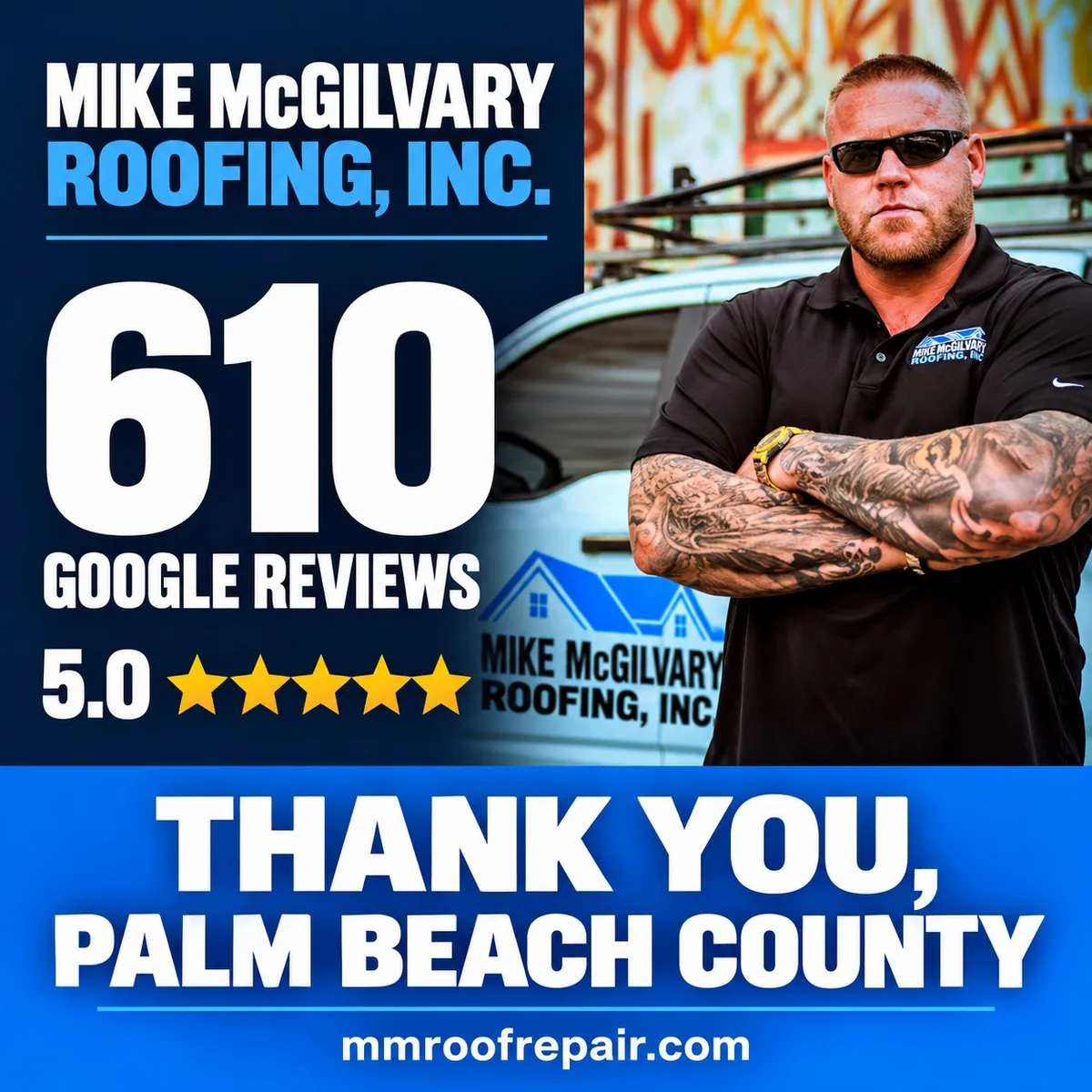
610 reviews at 5.0: why it matters for this checklist
This week our Google Business Profile reached 610 reviews with a 5.0 rating. We are grateful, and we mention it here for one reason: the checklist below is not theory. It is what we do on every inspection and repair, and the reviews are from the homeowners, estates, property managers and boards who received that documentation.
One of the newest reviews, from Libby Russ on November 2, is three words long: “Honest and responsive!!!” That is the standard. Honest about what the roof needs, responsive when you need the paperwork.
The roof-age documentation checklist
Keep these in one folder, digital or paper. If you are an MMR customer, your closeout packet already contains items 2 through 6 for the work we performed.
1. Your roof’s installation date
Find the date when 100 percent of the roof surface was last installed or replaced. The permit record from your county building department is the best source. If the roof was replaced in phases, note each phase. This date, not a repair date, is your roof age under 627.7011(5)(d).
2. A current roof inspection report with photos
A written report from an authorized inspector that states what was inspected, what was found, and the inspector’s opinion of remaining useful life. The statute’s five-year threshold depends on this document. Photos should show the whole roof and every deficiency noted, with a date. If you need a report that an insurer or buyer can rely on, see our 2-year vs. 5-year roof certification comparison.
3. Repair scope and closeout for every repair
Each repair should have a written scope that says what was repaired, where on the roof, and with what materials, plus before-and-after photos and a paid invoice. Vague invoices that say “roof repair” do not help an agent or inspector. See how we write ours on the Roof Repair Scope Documentation page.
4. Permits, where required
If a repair or replacement required a permit, keep the permit number and final inspection record. Not every repair requires a permit; your contractor should tell you in writing whether one was pulled and why or why not.
5. Wind mitigation inspection, if you have one
A wind mitigation report (Form OIR-B1-1802) documents roof covering, deck attachment, roof-to-wall connection and other features that carriers consider. It is a separate document from a roof condition inspection. Our Florida wind mitigation checklist explains what is on it.
6. Warranty and manufacturer documents
Keep any workmanship warranty from the contractor and any manufacturer documentation for materials used. Note the warranty start date and term.
7. Your policy’s roof coverage language
Ask your agent whether your roof is covered at replacement cost or actual cash value, and whether any roof-age or roof-condition endorsements apply. This is a question for your agent, not your roofer. Our October 19 article on Florida roof insurance, roof age and condo planning explains why the question matters.
8. A one-page roof history summary
A single page that lists the installation date, every inspection date, every repair with its scope, and the current condition finding. When an agent, underwriter, buyer or board member asks “what is the story with the roof,” you hand them this page and the folder behind it.
What if the inspection says replacement?
Sometimes it does. Underlayment that has failed across the whole roof, widespread deck deterioration or a tile system at the end of its life can all point to replacement. When that is the honest finding, we say so, and the same documentation rules apply: the inspection report explains why, the scope describes the full system being installed, and the closeout records the new installation date that will define your roof age going forward.
Our article on when a roof actually needs replacement covers the signs. And if you are weighing a replacement for insurance reasons, read our October 29 article on whether a new roof lowers your premium before you decide.

For condo boards, HOAs and property managers
The same checklist applies at the building level, with two additions:
- Keep inspection reports and repair closeouts by building and by roof section, so a lender, reserve professional or insurer can see the history of each roof rather than one summary for the whole community.
- Separate active repairs, preservation work and future replacement planning in your records. That separation supports reserve planning and buyer financing conversations, and it keeps a repairable roof from being lumped into a replacement budget before its time.
MMR provides the field evidence: photos, findings and documented scope. Reserve studies, structural determinations and the SIRS itself remain the responsibility of the qualified engineer, architect or reserve professional.
Why we keep saying this
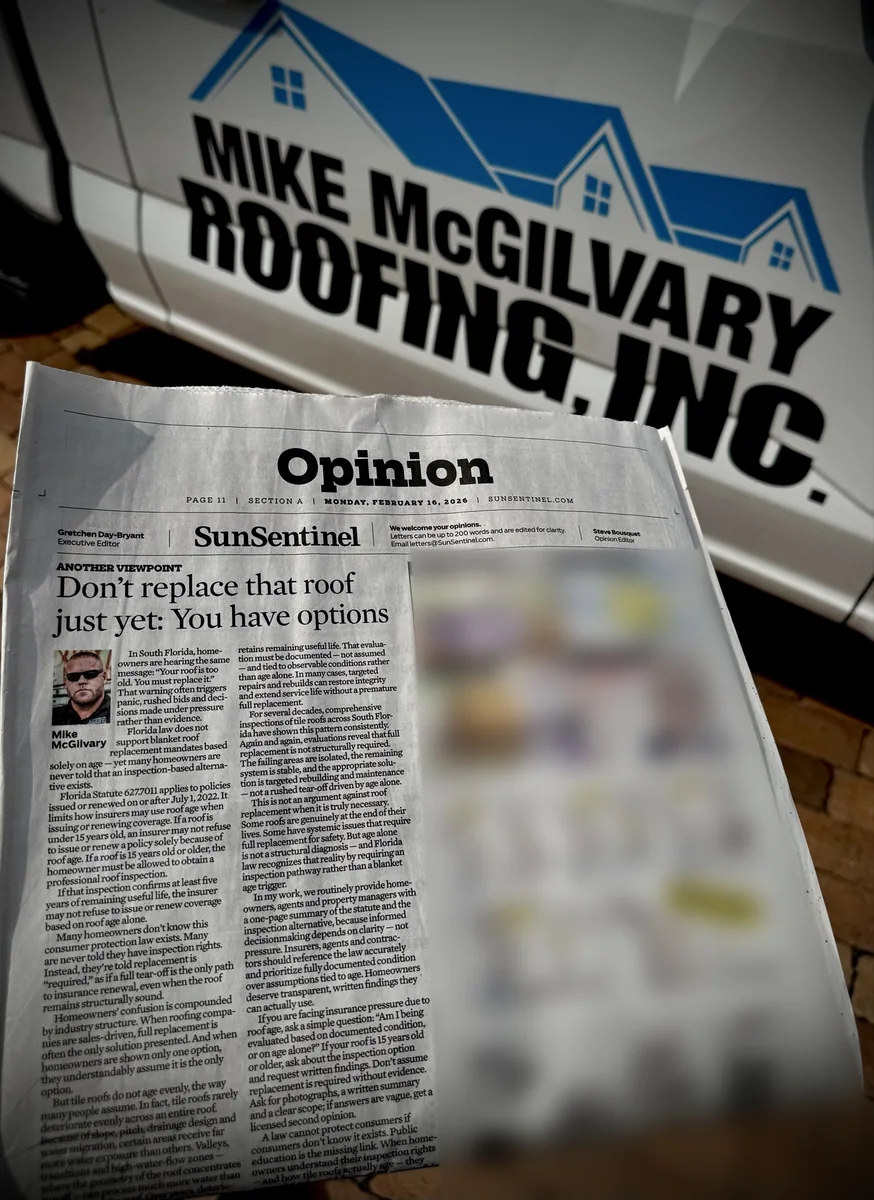
In February 2026 the Sun Sentinel published my opinion piece, “Don’t replace that roof just yet: You have options”. The point of that piece was the same as this checklist: Florida law does not support blanket roof replacement mandates based solely on age, yet many homeowners are never told that an inspection-based alternative exists.
Nine months later, the message has not changed. The season is ending, renewals are coming, and the owners who come out ahead are the ones with a current inspection, completed repairs and a complete folder.
Your end-of-season action list
For homeowners:
- Schedule a roof inspection in November, before renewal paperwork arrives
- Repair the deficiencies the inspection finds, and get a written scope and closeout for each
- Confirm your roof’s installation date from the permit record
- If your Citizens policy is transferring November 17 or December 15, have your folder ready for the new carrier
- Ask your agent one question: “Is my roof evaluated on documented condition, or on age alone?”
For boards and managers:
- Order a documented condition report for each building
- File inspection reports and closeouts by building and roof section
- Separate active repairs, preservation and replacement planning in the budget
- Keep warranties, permits and closeouts available for lenders, insurers and buyers
Frequently asked questions
Does Florida law stop my insurer from dropping me because my roof is 15 years old?
Under Florida Statute 627.7011(5)(c), an insurer may not refuse to issue or renew a homeowner’s policy solely because of roof age if an authorized inspection shows the roof has five or more years of useful life remaining. The insurer can still evaluate the roof’s condition, and the law applies to the specific circumstances described in the statute.
Does a roof repair reset my roof’s age?
No. Under 627.7011(5)(d), roof age is calculated from the last date on which 100 percent of the roof surface was built or replaced. Repairs can correct deficiencies and create a documented record, but they do not change the roof’s age.
Who counts as an “authorized inspector”?
The statute refers to an inspection performed by an authorized inspector. Ask your insurance agent which inspector credentials your carrier accepts before you schedule, so the report you pay for is the report they will review.
Is the end of hurricane season really a better time to inspect than the start?
Both matter. A pre-season inspection prepares the roof for storms. A post-season inspection documents what the season did and gets repairs closed out before renewal and policy-transfer paperwork arrives. If you can only do one this year, do the one in front of you now.
What should a repair invoice say?
What was repaired, where on the roof, what materials were used, the date, and the amount paid, with before-and-after photos. “Roof repair” by itself is not a record an agent or inspector can use.
Does MMR’s documentation guarantee my insurance outcome?
No. We document the roof’s condition and the work performed. Insurers make their own underwriting decisions. A complete record gives you and your agent the evidence to have that conversation on condition rather than age alone.
Talk to a repair-first Palm Beach County roofer
Mike McGilvary Roofing, Inc. is a licensed Florida Certified Roofing Contractor (CCC1331721) serving Palm Beach County homeowners, estates, HOAs and condominium associations, with 610 Google reviews at a 5.0 rating as of November 2, 2026. We start with an honest inspection, repair what needs to be repaired, preserve what can be preserved, and document everything so you are ready for insurance, financing and your next roof decision.
Condition first. Evidence always. Contact MMR to schedule your end-of-season roof inspection or request a copy of your roof record.
This article is for general educational purposes and is not legal or insurance advice. Mike McGilvary Roofing does not guarantee insurance approval, renewal, premium reductions or a specific remaining useful life. Consult your insurance agent, association attorney or qualified reserve professional for advice about your specific policy or property. Customer reviews quoted are public Google reviews and reflect those customers’ individual experiences. Review count and rating current as of November 2, 2026. Statute and regulatory sources current as of November 2, 2026.