
One of the most expensive mistakes a Palm Beach County homeowner can make is spending money on the wrong roof scope — pouring cash into repairs on a roof that’s genuinely finished, or tearing off and replacing a roof that could have been preserved for a fraction of the cost. Both errors are common, and both are avoidable. At Mike McGilvary Roofing we’re repair-first, but we’re not repair-blind: the right call comes from a documented, condition-based inspection of your actual roof — not from its age, not from fear, and not from a guess.
Here in South Florida, that distinction matters more than almost anywhere. Roof age does not equal roof condition. A leak does not automatically mean replacement. And an old roof is not automatically a dead roof. This is the framework we use to help homeowners across Palm Beach County decide whether to repair, rebuild, certify, preserve, or replace — before anyone spends a dollar.
The 5 questions every homeowner should ask before deciding
Before you accept a repair estimate or a replacement quote, work through these five questions. They’re the same ones we answer on every roof inspection.
- 1. How old is the roof system compared to realistic South Florida service life? Not just the calendar age — how does it compare to what this roof type actually delivers in our sun, salt air, and storm exposure? A tile roof and a shingle roof at the same age are in very different places.
- 2. Is the failure isolated or systemic? A single leak at a valley or pipe boot is a very different problem than moisture showing up in multiple, unrelated areas. Isolated failures point toward repair; systemic ones point toward replacement.
- 3. Has the roof had prior repairs that affect Florida Building Code repair thresholds? Florida’s code limits how much of a roof can be repaired within a rolling window before the work must meet current code. Extensive prior patching can change what’s permissible — which is a documentation-and-scoping question, not a guess.
- 4. Will the roof still satisfy insurance and remaining-useful-life concerns after the repair? A repair that fixes the leak but leaves the roof uninsurable hasn’t solved your real problem. The repair has to leave you with a roof that’s both sound and documentable.
- 5. Does the repair make financial sense compared to replacement over time? The honest measure isn’t just the quote — it’s cost per year of service. A $4,000 repair that buys ten more years beats a repair that only delays an inevitable replacement by a season.
The tile-roof preservation advantage in Palm Beach County
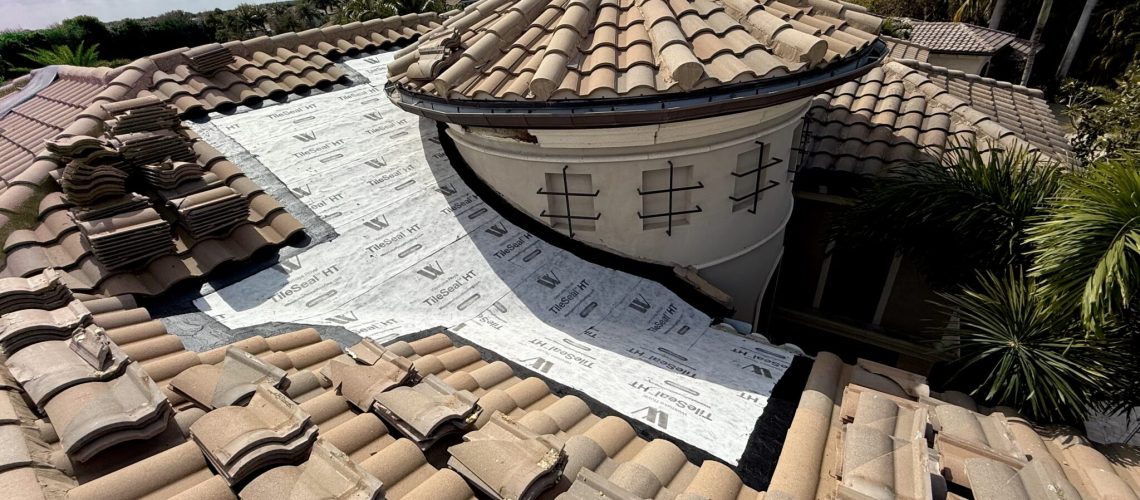
This is where so many Palm Beach County homeowners are needlessly talked into a full replacement. A huge share of homes here have tile roofs — and a tile roof does not need to be replaced simply because it’s older. The tiles themselves, clay or concrete, can last fifty years or more. What fails first is almost always underneath them: the underlayment, flashings, valleys, penetrations, and mortar areas.
When those elements fail, the fix usually isn’t a tear-off — it’s a targeted rebuild. We lift and catalog the sound tile, rebuild the waterproofing system beneath it, and re-lay the same tile back over it. That’s tile roof preservation, and it’s the heart of our repair, rebuild, certify, and preserve approach. For the right roof, it solves the actual problem and avoids the enormous cost of an unnecessary replacement. (For the specifics of how tile fails and gets rebuilt, see our tile roof repair page.)
When repair makes sense
Repair is usually the right answer when the damage is contained and the underlying system is still sound. Typical repair-appropriate situations include:
- An isolated leak
- Cracked or displaced tiles
- A localized flashing issue
- A pipe boot or penetration issue
- A valley or roof-to-wall transition leak
- A roof that still has strong remaining useful life
- Sound decking beneath the affected area
- No widespread, system-wide failure
In these cases, a well-executed roof repair preserves a good roof and keeps your money where it belongs.
When replacement makes sense
Sometimes replacement genuinely is the right, honest answer — and when it is, we’ll tell you plainly. Replacement usually makes sense when:
- There are multiple, recurring leaks
- The underlayment has failed widely across the roof
- Decking is rotten across multiple areas
- The roof has already been extensively patched
- The roof can’t reasonably satisfy insurance concerns even after repair
- Repair cost is too close to replacement value to justify
- The system is near the end of its useful life and repairs would only delay the inevitable
Replacement isn’t a failure of the repair-first philosophy — it’s the conclusion of an honest evaluation. The goal is the right scope, not the biggest one.
Florida’s Roof Age Law and the insurance angle
Florida changed how a roof’s age can be used against a homeowner — but the burden of proof still runs through documentation. Under Florida’s Roof Age Law, an older but well-maintained roof can remain insurable when its condition and remaining useful life are properly documented. The flip side is just as important: a newer roof in poor condition can still create problems. Age cuts both ways; condition is what actually decides.
That’s why the repair-vs-replacement decision and the insurance decision are really the same decision. A signed roof certification documenting the roof’s condition is what turns “my roof is old” from a liability into a documented, insurable fact — and it’s exactly what we produce when a roof qualifies.
How Mike McGilvary Roofing decides — our process
Every repair-or-replace recommendation we make follows the same documented process, so you’re never asked to take our word for it:
- Inspect the actual roof condition — on the roof, not from the driveway
- Determine whether the damage is isolated or systemic
- Photograph the problem areas so you can see what we see
- Review the repair vs. replacement options honestly, including cost over time
- Provide a clear, written scope of work
- Help you understand whether repair, rebuild, certification, preservation, or replacement is the right path for your roof
We do this across Palm Beach County — from Boca Raton and Delray Beach to Wellington, Jupiter, and Palm Beach — and everywhere in between.
Important note. This article is general educational information, not legal, insurance, or code-compliance advice. Whether a roof should be repaired, rebuilt, certified, preserved, or replaced depends on its actual condition as determined by inspection; Building Code application depends on your local building department; and coverage decisions rest with your insurer. Documentation may support insurance and maintenance decisions but is not a guarantee of any coverage outcome.
Frequently Asked Questions
Does an old roof automatically need to be replaced in Florida?
No. Roof age is not the same as roof condition. An older but well-maintained roof — especially a tile roof — can have significant remaining useful life and remain insurable when its condition is properly documented. The right decision comes from a condition-based inspection, not the roof’s age alone.
How do I know if my roof needs repair or full replacement?
The key questions are whether the failure is isolated or systemic, whether the decking and underlying system are still sound, whether the roof will remain insurable after a repair, and whether the repair makes financial sense over time versus replacement. A documented roof inspection answers all of these so the decision is based on evidence rather than guesswork.
Can a Palm Beach County tile roof be repaired instead of replaced?
Very often, yes. On tile roofs, the tiles themselves can last fifty years or more, while the underlayment, flashings, valleys, and penetrations beneath them fail first. Rebuilding those elements and re-laying the sound tile — tile roof preservation — frequently avoids an unnecessary full replacement.
Will my insurance accept a repaired roof?
It depends on the roof’s documented condition. Under Florida’s Roof Age Law, an older roof can remain insurable when a documented inspection shows sufficient remaining useful life. A signed roof certification records that condition — the evidence an insurer’s underwriting looks for. Coverage decisions ultimately rest with the carrier.
Does prior roof patching affect whether I can repair again?
It can. Florida’s Building Code limits how much of a roof or roof section may be repaired within a rolling period before the work must meet current code. Extensive prior patching can change what’s permissible, which is why permit history and scope are part of a proper condition-based evaluation.
About Mike McGilvary Roofing
Mike McGilvary Roofing serves Palm Beach County and surrounding South Florida with a repair-first philosophy focused on condition-based roofing decisions — roof repair, tile roof preservation, roof certifications, and honest repair-vs-replacement guidance. Rather than recommending replacement based on a roof’s age, we inspect, document, and help homeowners choose the right scope for their actual roof. Learn more about Florida’s Roof Age Law or explore the Palm Beach County communities we serve.