
25-year-old tile roof in West Boca: restored and certified for 5+ years.
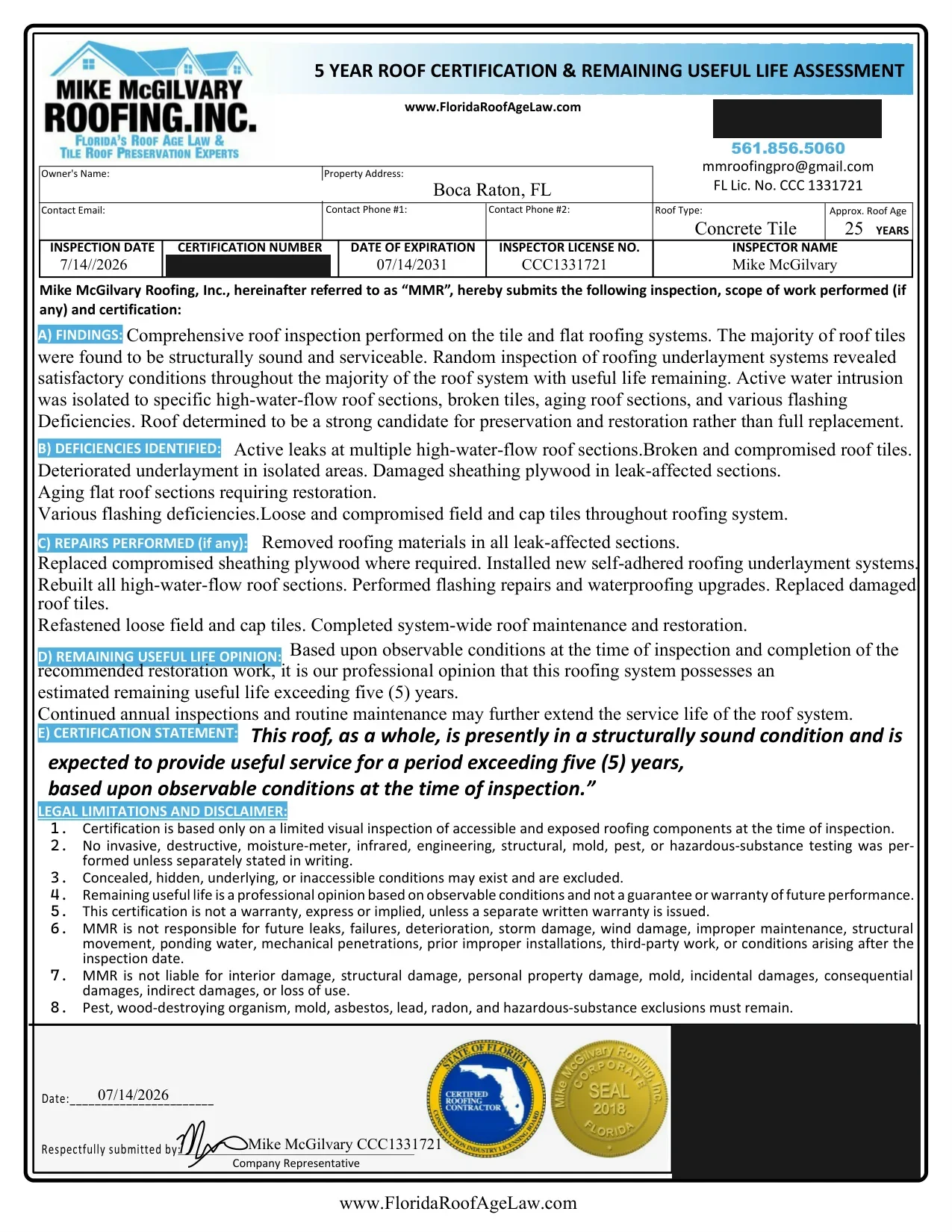
A roughly 25-year-old concrete tile roof in Boca Raton was leaking at several high-water-flow sections. Dirty water stains on a fascia board were the first clue; under the tile, the plywood deck had rotted through. Rather than treat the roof's age as a verdict, we opened only the failing sections, replaced the rotted decking, rebuilt the valleys with new underlayment, reinstalled the existing tile, and issued a signed 5-Year Roof Certification.
Localized failure — localized rebuild.
A condition-based tile roof restoration in Boca Raton, documented from the first stain on the fascia to the signed certification.
A stain on the fascia — and a deck that had quietly rotted.
From the ground, the roof looked like what it was: a 25-year-old concrete tile roof on a Boca Raton home. The tell was a run of dirty water staining on a fascia board — the kind of mark that means water has been getting behind the roofing system for a long time, not just since the last storm. There were active leaks at more than one high-water-flow section, and on a roof of that age the usual recommendation writes itself: replace it.
We inspected the whole roof first. The majority of the tile was structurally sound and serviceable. Random checks of the underlayment across the field found satisfactory conditions with useful life remaining. The deterioration was concentrated in the valleys and drainage paths — where two slopes meet and the roofing system takes the most water — and in the aging flat sections. When we opened the stained section, the findings confirmed the cause: the roof decking there had sustained significant wood rot from long-term water infiltration and had to be removed and replaced before anything could be properly restored.
That is a roof with failed sections, not a failed roof. The two call for very different work.
Documented findings — straight from the certification.
Every item below was photographed and recorded in the certification package the homeowner received. It documents the roof’s condition and remaining useful life.
Findings
- Comprehensive inspection performed on the tile and flat roofing systems.
- The majority of roof tiles were structurally sound and serviceable.
- Random inspection of the underlayment found satisfactory conditions across most of the roof, with useful life remaining.
- Active water intrusion was isolated to specific high-water-flow sections, broken tiles, aging sections, and flashing deficiencies.
- Conclusion: a strong candidate for preservation and restoration rather than full replacement.
Deficiencies identified
- Active leaks at multiple high-water-flow roof sections.
- Broken and compromised roof tiles.
- Deteriorated underlayment in isolated areas.
- Damaged sheathing plywood in the leak-affected sections.
- Aging flat roof sections requiring restoration.
- Various flashing deficiencies; loose field and cap tiles throughout the system.
Opened what had failed — rebuilt it from the deck up.
The repairs performed, in sequence. Each failing section was stripped to the deck, rebuilt, waterproofed, and tied back into the sound roof around it before the original tile went back on.
- Removed roofing materials in every leak-affected sectionTile lifted and set aside at each failing valley and high-flow area so the deterioration could be seen and corrected at its source.
- Replaced compromised sheathing plywoodThe rotted decking under the stained fascia — and anywhere else the deck had been compromised — cut out and replaced with new plywood sheathing.
- Installed new self-adhered underlaymentNew roof tile underlayment over every rebuilt section, integrated with the surrounding system for a continuous waterproof layer.
- Rebuilt all high-water-flow roof sectionsEach valley and drainage path showing wear was rebuilt to a structurally sound, watertight condition — including the largest section on the roof.
- Flashing repairs, waterproofing upgrades, flat-roof restorationFlashing deficiencies corrected and the aging flat sections restored so the whole system sheds water the way it should.
- Replaced damaged tile, refastened loose field and cap tilesBroken tile swapped out, loose tiles re-secured, and the existing tile reinstalled in its original placement — then system-wide maintenance and restoration completed.
Eight photo exhibits, one signed certification.
These are the actual pages of the homeowner's certification package, with the address and owner details removed for privacy. Photos are useful. Photos attached to a licensed contractor's signed findings are proof.
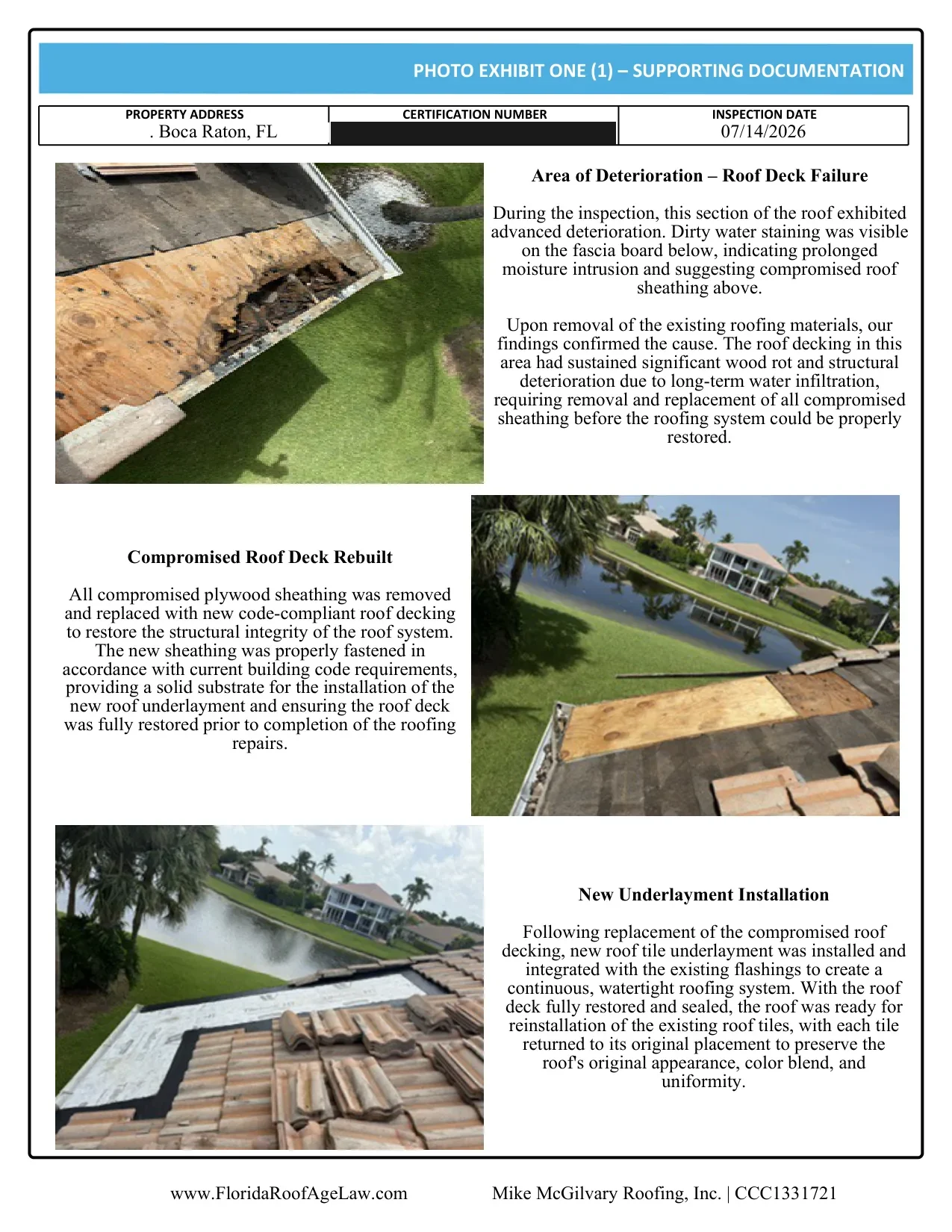
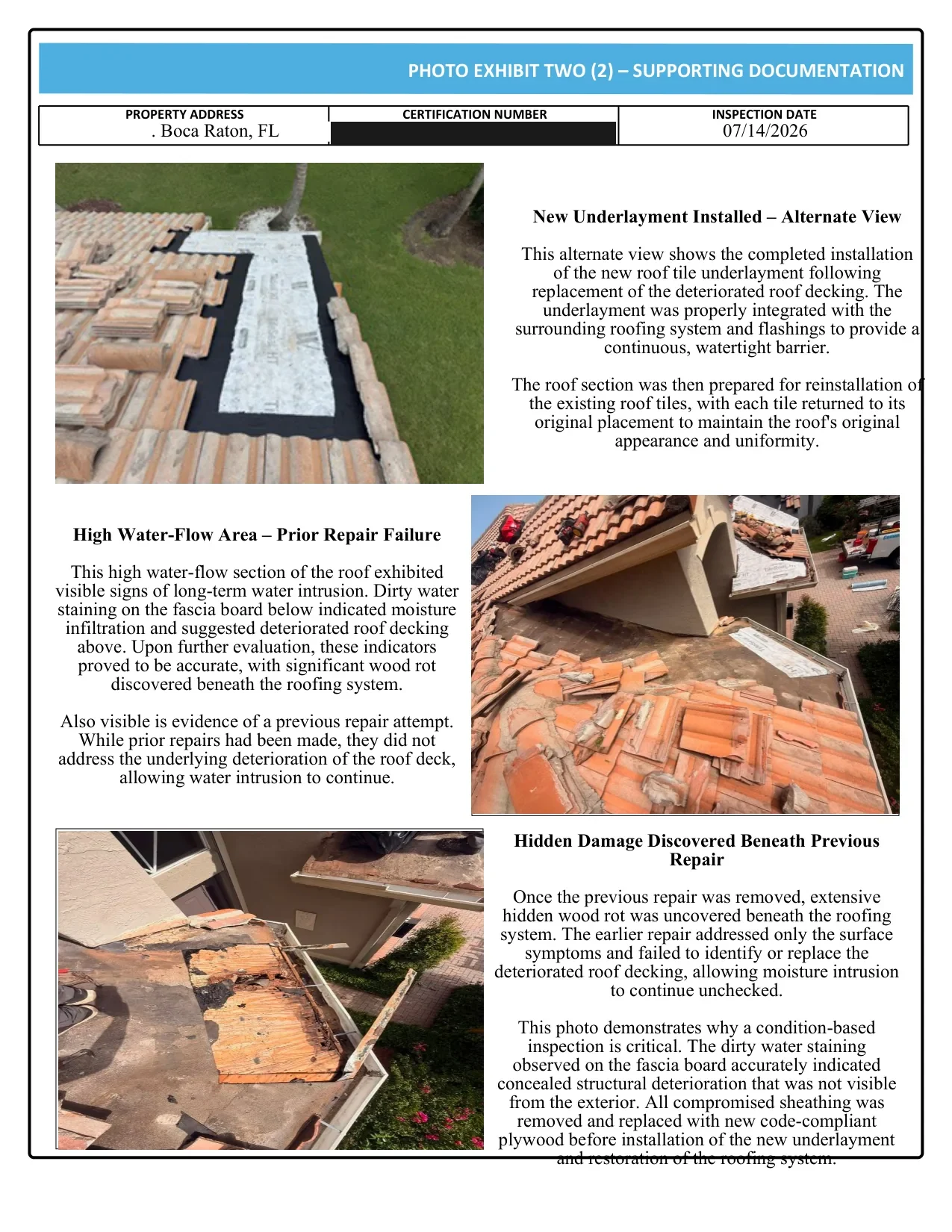
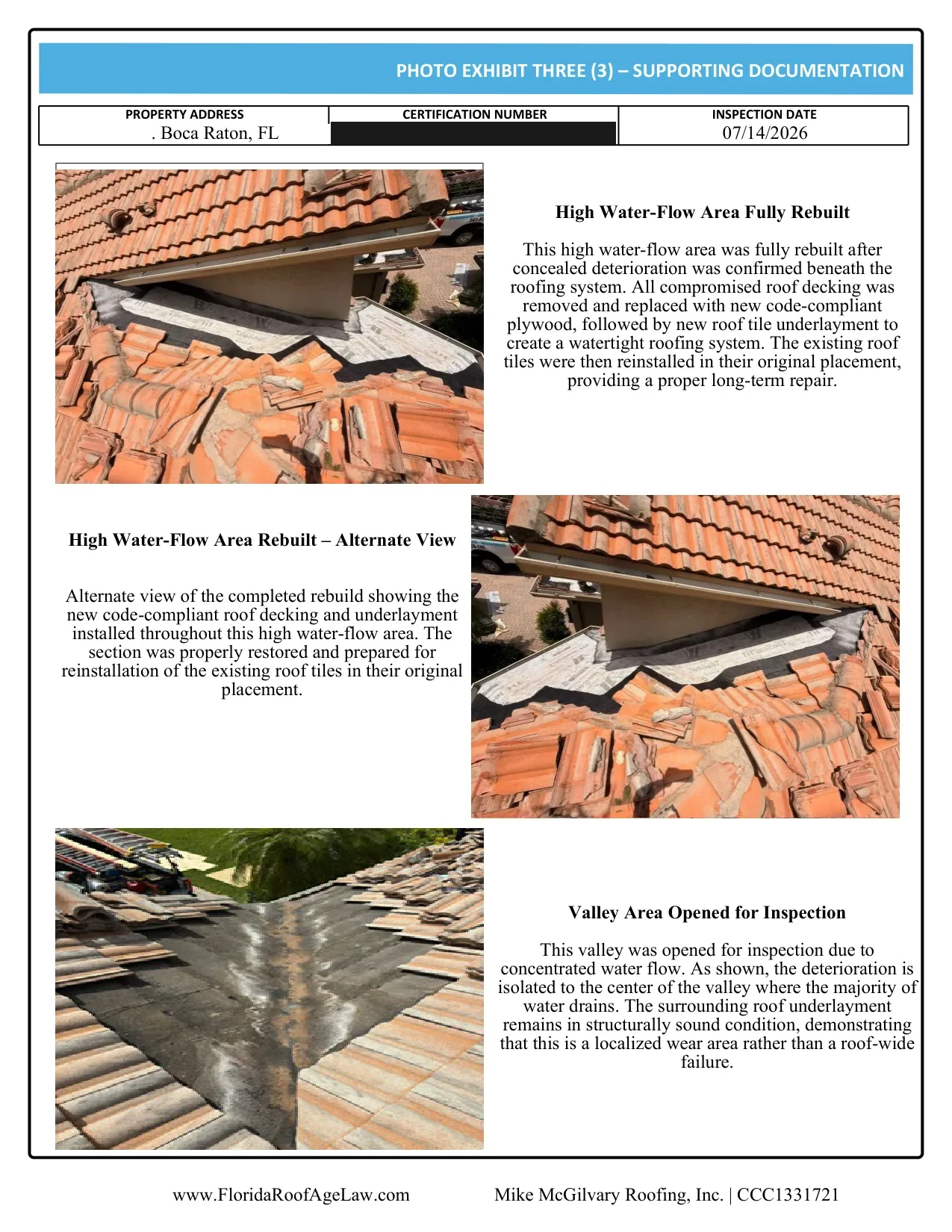
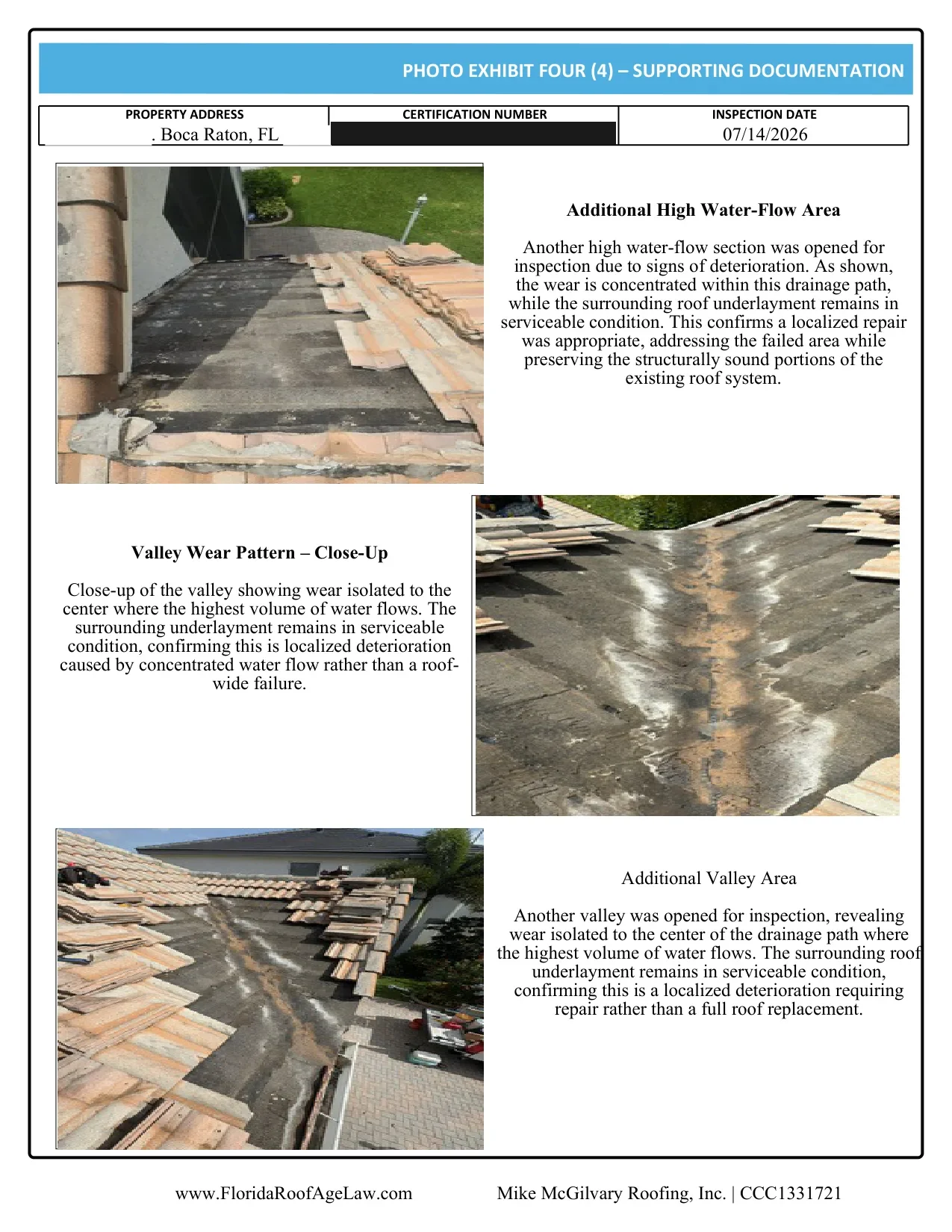
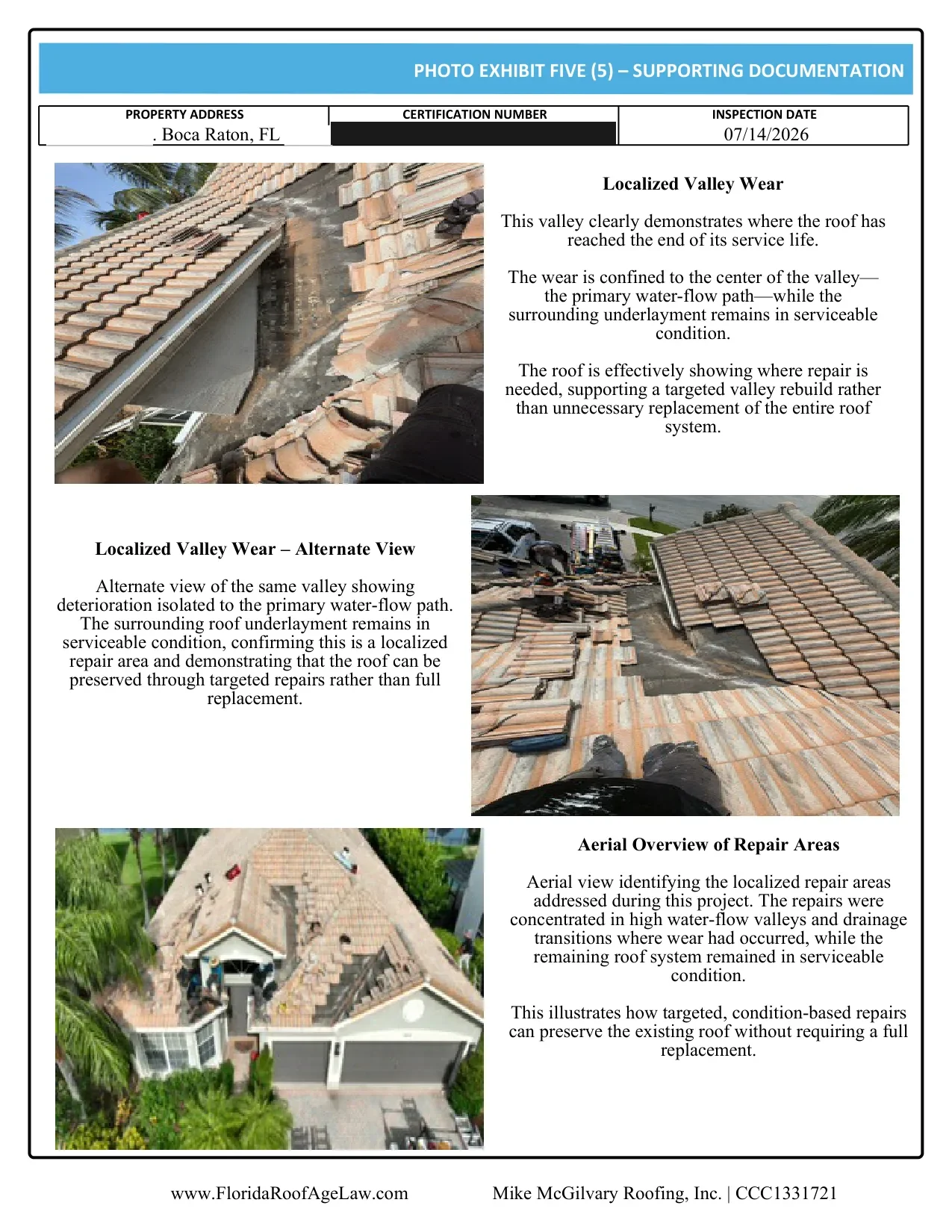
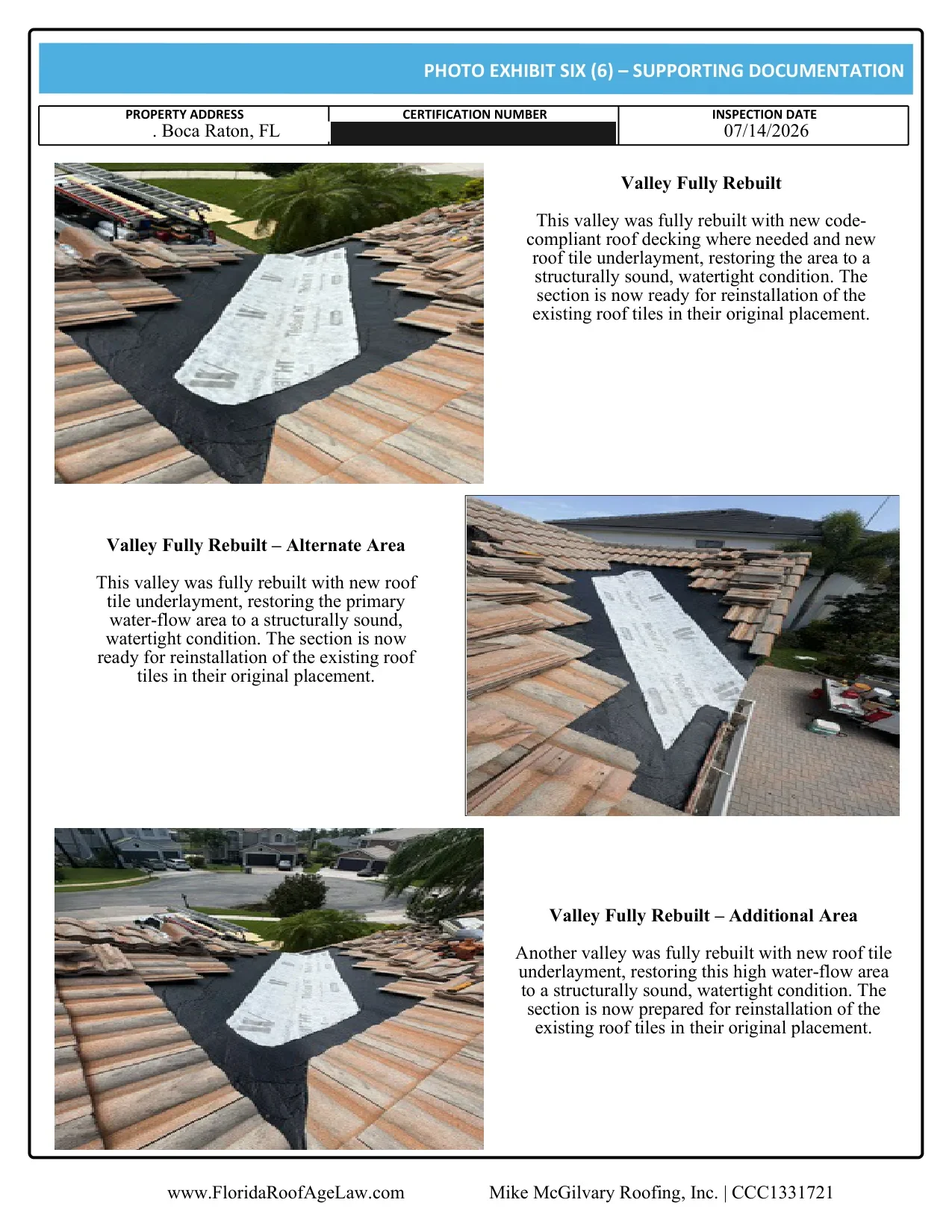
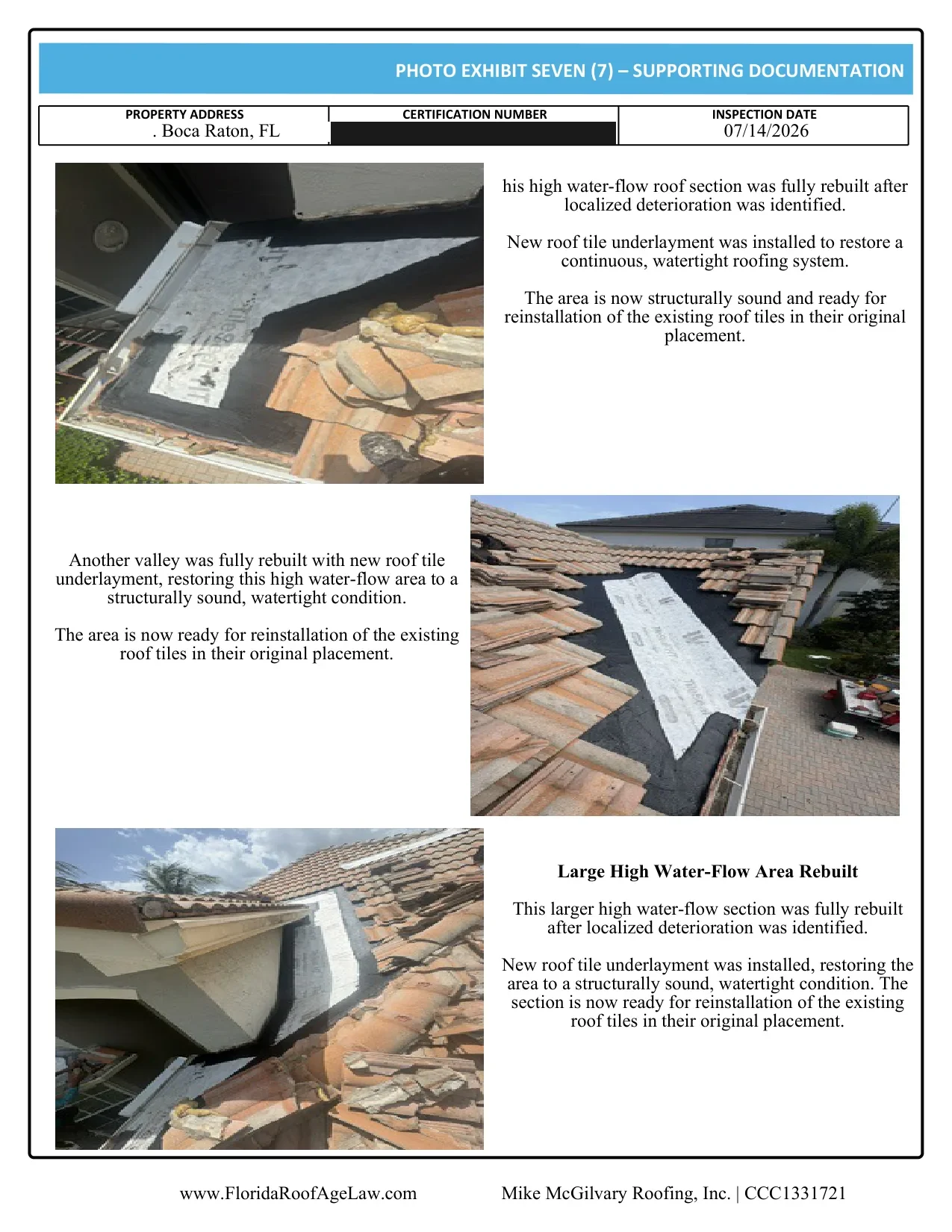
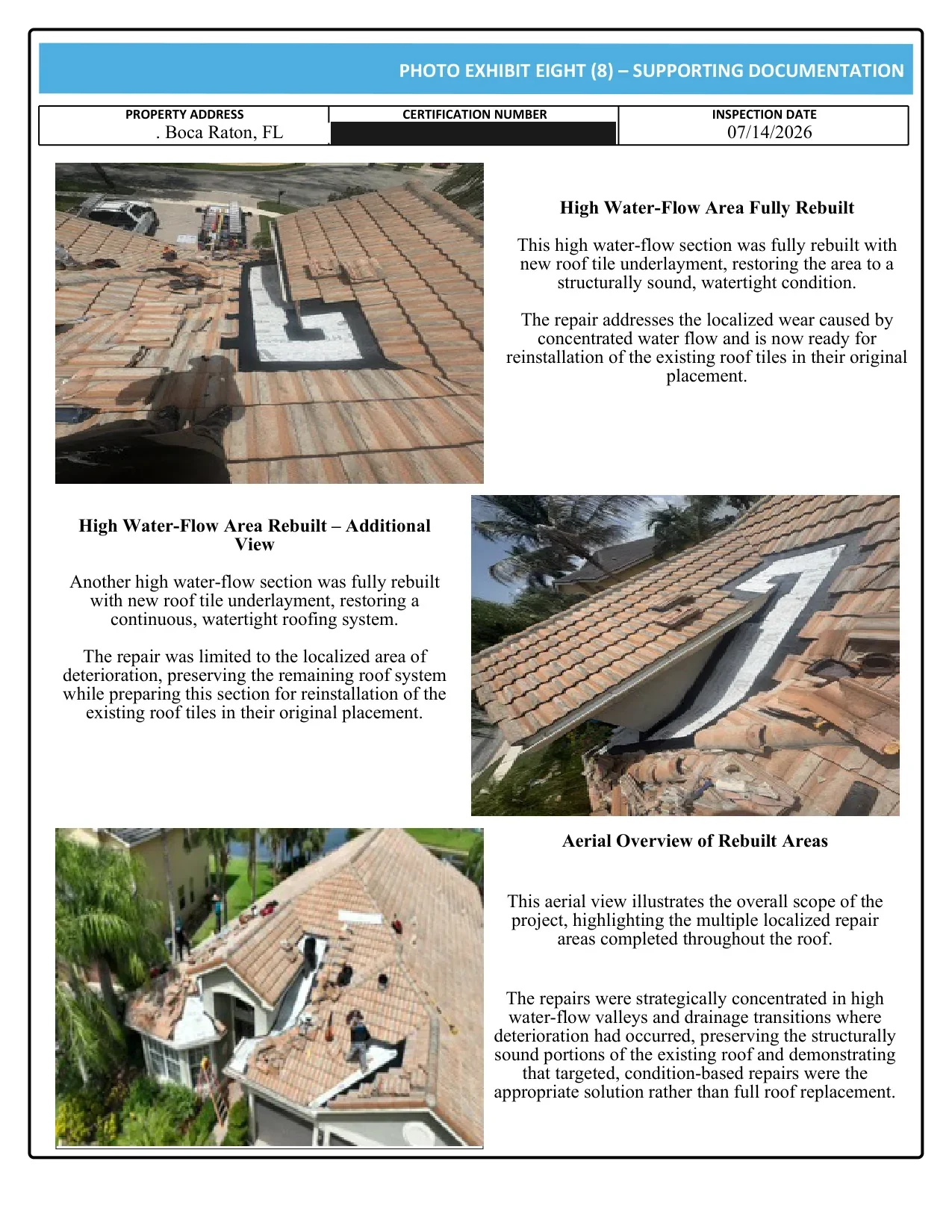
Address, owner, and contact details redacted for privacy · Real Mike McGilvary Roofing project · Boca Raton, FL 33498 · Concrete tile, about 25 years old · Inspected July 14, 2026
What this certificate says, and what it doesn’t
- Certification is based only on a limited visual inspection of accessible and exposed roofing components at the time of inspection.
- No invasive, destructive, moisture-meter, infrared, engineering, structural, mold, pest, or hazardous-substance testing was performed unless separately stated in writing.
- Concealed, hidden, underlying, or inaccessible conditions may exist and are excluded.
- Remaining useful life is a professional opinion based on observable conditions and not a guarantee or warranty of future performance.
- This certification is not a warranty, express or implied, unless a separate written warranty is issued.
Certified for five years — with the original tile back in place.
With the restoration complete, Mike inspected the finished roof and issued a signed 5-Year Roof Certification & Remaining Useful Life Assessment — inspected July 14, 2026 and valid through July 14, 2031. In the certificate’s own words: “This roof, as a whole, is presently in a structurally sound condition and is expected to provide useful service for a period exceeding five (5) years, based upon observable conditions at the time of inspection.” The homeowner kept a roof that still looks original, has a written record of exactly what was found and what was rebuilt, and did not pay for a tear-off that the roof's condition never called for.
Continued annual inspections and routine maintenance may further extend the service life of the roof system.
“Based upon observable conditions at the time of inspection and completion of the recommended restoration work, it is our professional opinion that this roofing system possesses an estimated remaining useful life exceeding five (5) years.”
Where the water runs is where the roof wears.
Properly installed concrete and clay tile usually outlasts the underlayment and flashing beneath it. What wears out first is the underlayment and decking, and it wears fastest in the valleys and drainage paths that carry the most water. That is exactly the pattern this roof showed: the wear on each opened valley was confined to the center of the drainage path, while the underlayment on either side was still serviceable. The exhibit pages above show it plainly.
We inspect first and evaluate whether repairs or targeted rebuilding can extend the roof's useful life before recommending full replacement. When the evidence shows localized deterioration on a roof that is otherwise sound, rebuilding the failed sections — deck, underlayment, flashing — and reinstalling the existing tile is the recommendation we can sign. It is the same approach we documented on a larger Boca Raton tile-and-flat-roof estate, and it is how we approach repair versus replacement on every roof we inspect.
Related & nearby.
Roof Repair in Boca Raton
How we approach tile, flat, and leak repair across Boca's country-club, estate, and coastal neighborhoods.
Boca Raton roofing →Boca Raton Estate Case Study
A tile-and-flat-roof estate restored section by section and certified for five years.
Read the estate study →5-Year Roof Certifications
What a certification documents — shown page by page.
See certifications →Roof Rebuilds
Rebuilding failed valleys, decks, and sections — without tearing off the roof.
Roof rebuilds →Tile Roof Preservation
Keeping sound tile in service by replacing what fails beneath it.
Tile preservation →Florida Roof Age Law
Why condition — not age — should drive the repair-or-replace decision.
Read the guide →Rotted decks and rebuilt valleys, answered.
If the roof deck is rotted, doesn't the roof need to be replaced?
What does dirty water staining on a fascia board mean?
How do you know the rest of the roof was still sound?
Can a repaired 25-year-old tile roof be certified?
How does this relate to Florida's roof age law?
Details of this project have been anonymized for the homeowner's privacy. Every roof is different; the condition, scope, and outcome described here are specific to this project and are not a quote, a guarantee, or a promise of any particular insurance result. Whether any roof qualifies for repair or certification depends on its actual condition as determined by inspection. A roof certification is based on a limited visual inspection of accessible components, is a professional opinion and not a warranty, and does not guarantee any insurer's decision.
Stains on the fascia? Leaks at the valleys?
Get a free, documented, condition-based inspection from a Palm Beach County roofing family licensed since 1974. We'll show you exactly what we find — and whether it's a section rebuild, a repair, or truly time to replace.