
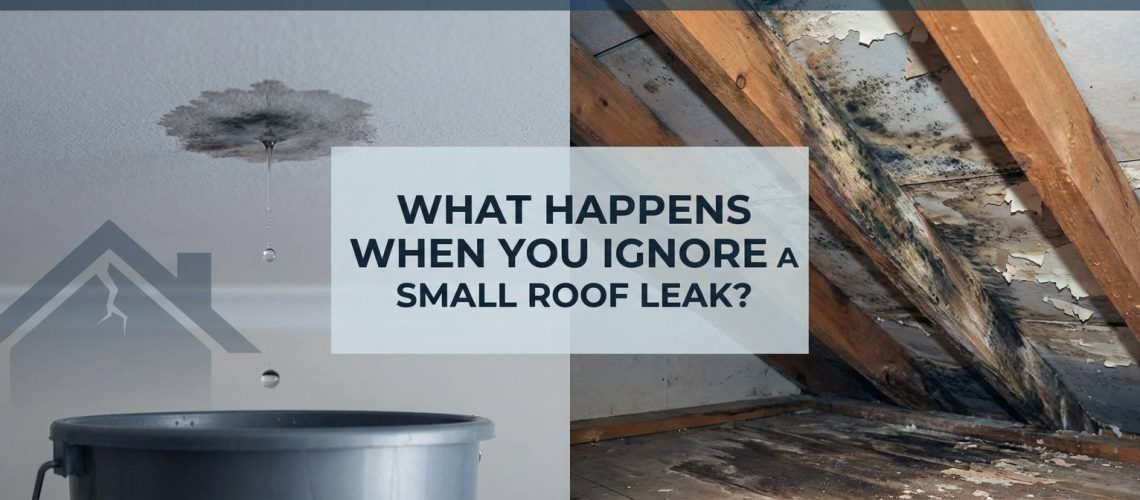
A small water stain on your ceiling might seem like a minor inconvenience—something you’ll “get to eventually.” But that innocent-looking discoloration represents water that’s traveled through multiple layers of your roof system, and it’s causing damage every single day you wait. In South Florida’s humid climate, what starts as a $500 repair can escalate into a $15,000 structural nightmare faster than most homeowners realize.
After five decades of roofing in Palm Beach County, I’ve walked into hundreds of homes where owners knew about a small leak for months or even years before calling. The cost of delaying roof repair is never just financial—it’s structural, it’s health-related, and it compounds exponentially the longer you wait.
The True Path of a Roof Leak
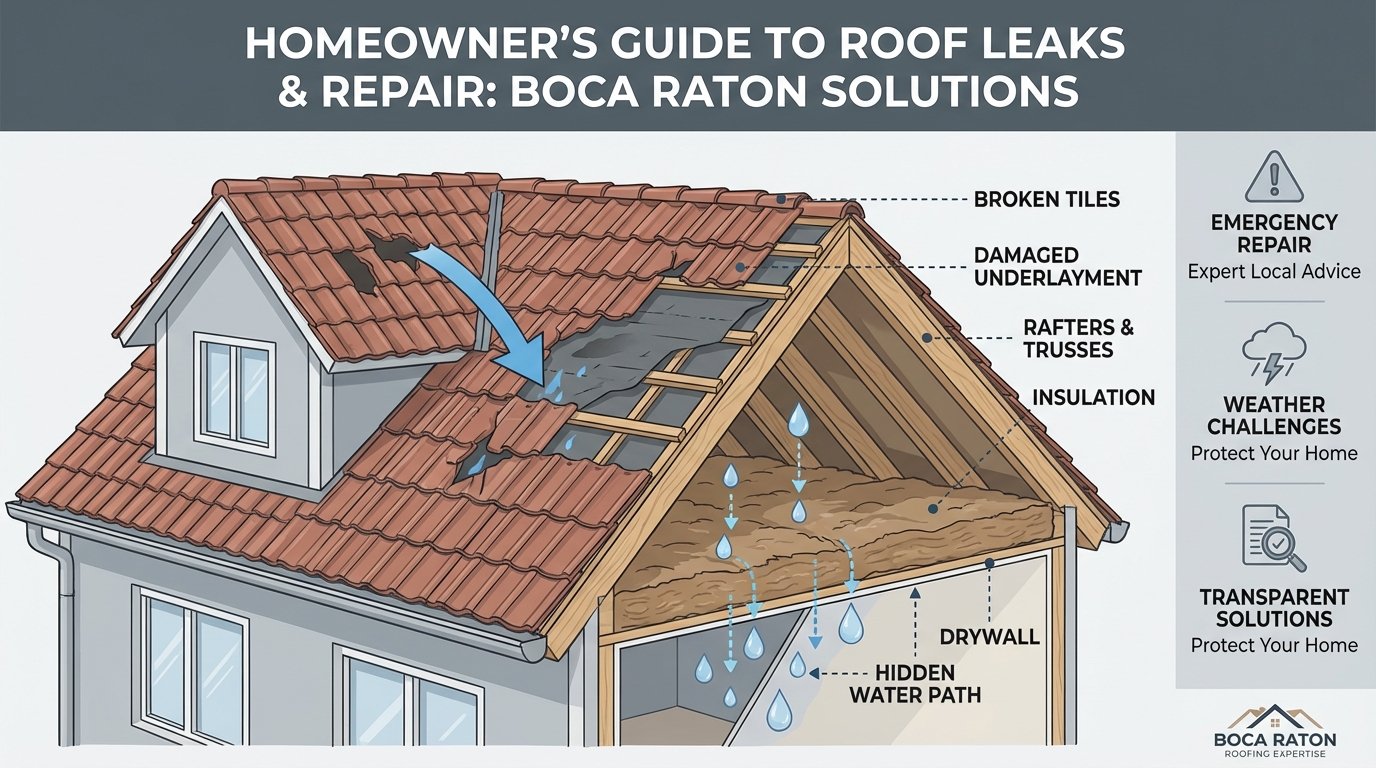
Understanding what’s actually happening behind your walls helps explain why ignoring roof leak consequences is never the money-saving strategy it appears to be.
Stage One: Initial Water Intrusion
When water first penetrates your roof covering—whether through damaged tile, compromised flashing, or deteriorated underlayment—it doesn’t immediately drip onto your ceiling. It begins a destructive journey through your roof system:
- Underlayment saturation: Modern synthetic underlayment resists water, but older tar paper or felt absorbs moisture, remaining damp for extended periods
- Decking exposure: Water reaches plywood or OSB decking, which begins absorbing moisture along grain lines
- Insulation contact: Water drips onto attic insulation, which acts like a sponge, holding moisture against wood framing
- Visible ceiling stain: By the time you see discoloration, water has already compromised multiple roof layers
That small stain represents the visible tip of a much larger moisture problem already underway.
Stage Two: Material Deterioration Begins
Wood doesn’t fail immediately when exposed to water—it’s a gradual process accelerated by Florida’s heat and humidity. Within weeks of initial intrusion:
Plywood delamination: Roof decking is constructed of thin wood layers bonded with adhesive. Water causes these layers to separate, creating soft spots that no longer provide proper fastening for roof covering. A single sheet of damaged decking costs $150-300 to replace, but if the leak continues for months, you might need to replace six sheets at $900-1,800.
Rafter deterioration: Roof framing lumber that stays wet begins losing structural integrity. In South Florida’s climate, this process accelerates because high temperatures speed biological decay. A minor leak affecting one rafter is a $400-600 repair. A long-term leak compromising three rafters becomes a $2,000-4,000 structural project.
Fascia and soffit damage: Water often travels along rafters to roof edges, rotting fascia boards and soffit panels. This exterior damage invites pest intrusion and creates additional entry points for water during wind-driven rain.
The Mold Reality in South Florida
Roof leak mold isn’t just about unsightly black spots—it’s a health hazard and a home value destroyer. South Florida’s combination of heat, humidity, and air conditioning creates perfect conditions for rapid mold proliferation.
How Quickly Mold Develops
The timeline is alarming: mold spores can begin colonizing damp surfaces within 24-48 hours of water exposure. In an attic where temperatures regularly exceed 120°F and humidity stays high, that small roof leak creates an ideal mold incubator.
Active mold growth typically becomes visible within 7-10 days, but the real problem occurs in hidden spaces—inside wall cavities, behind insulation, along the backside of drywall. By the time you see mold on your ceiling, extensive growth has likely occurred in spaces you can’t observe.
Health Implications
Mold exposure causes respiratory issues, allergic reactions, and aggravates asthma, particularly in children and elderly residents. Some mold species produce mycotoxins that create more severe health effects. Once mold establishes itself in your attic or wall cavities, spores circulate through your HVAC system, affecting indoor air quality throughout your home.
Remediation Costs
Professional mold remediation isn’t optional if growth becomes extensive—it’s required by most insurance policies and home sale contracts. Remediation involves:
- Containment barriers to prevent spore spread during removal
- HEPA air filtration during the remediation process
- Removal and disposal of contaminated materials (insulation, drywall, wood)
- Antimicrobial treatment of affected surfaces
- Post-remediation testing to verify complete removal
A modest mold remediation project starts at $3,000-5,000. Extensive attic mold removal can reach $10,000-15,000. This is completely separate from repairing the roof leak that caused the problem and replacing damaged structural components.
Small Roof Leak Damage: The Domino Effect
Water damage rarely stays confined to the initial intrusion point. Understanding how small roof leak damage spreads explains why early intervention saves so much money.
Electrical System Compromise
Attic spaces contain electrical wiring, junction boxes, and sometimes HVAC equipment. Water intrusion creates serious safety hazards:
Wire insulation damage: Water exposure degrades wire insulation, creating shock and fire risks. Rewiring affected circuits costs $500-1,500 depending on accessibility.
Junction box corrosion: Moisture causes corrosion in electrical connections, leading to circuit failures and potential arcing. Junction box replacement runs $200-400 per box.
HVAC equipment damage: Air handlers or ductwork in attics can suffer water damage, leading to equipment failure or duct replacement at thousands of dollars.
Insulation Replacement
Wet insulation loses R-value permanently and must be replaced—you can’t dry it out and restore its effectiveness. Blown-in insulation costs $1.50-2.50 per square foot installed. A leak affecting 400 square feet of attic space requires $600-1,000 in insulation replacement alone.
Interior Damage Migration
Water doesn’t respect boundaries. A roof leak in your attic eventually affects interior spaces:
- Ceiling drywall: Water-stained or sagging drywall requires cutting out damaged sections and patching, then texture-matching and painting ($400-800 per ceiling)
- Wall damage: Water travels down wall cavities, staining and damaging drywall in rooms below the leak ($300-600 per affected wall)
- Paint and finishes: Water intrusion ruins paint, creating the need for complete room repainting ($500-1,500 depending on room size)
- Flooring: Severe leaks eventually reach flooring, warping hardwood, damaging carpeting, or staining tile ($2,000-8,000 for room flooring replacement)
How a Roof Leak Gets Worse: The Expansion Pattern
Roof leaks never remain static—they expand through predictable patterns that accelerate over time.
Underlayment Deterioration
Once water finds a path through your primary roof covering, it begins degrading underlayment around the initial failure point. Think of it like a crack in a windshield—the compromised area spreads outward as thermal expansion and contraction stress the weakened material.
A leak starting from a single damaged roof tile can expand to affect a 4×4-foot area of underlayment within six months. After a year, that damaged section might span 8×8 feet, requiring substantially more expensive repairs.
Fastener Corrosion
Water exposure causes roof fasteners (nails or screws) to corrode. As fasteners weaken, roof covering becomes loose, allowing wind to lift tiles or shingles. This creates additional leak points and accelerates the expansion of water intrusion.
During hurricane season, a roof section weakened by leaked-related fastener corrosion becomes vulnerable to blow-off, potentially exposing large roof sections to direct rainfall and causing catastrophic interior damage.
Secondary Leak Development
The most insidious pattern: roof leaks create conditions that spawn additional leaks. Moisture-damaged decking allows fasteners to pull out more easily during wind events. Rotted wood around one penetration stresses adjacent flashing. Water pooling on deteriorated underlayment finds multiple paths through compromised roof systems.
Homeowners often call reporting that their “small leak” suddenly became “three or four leaks” after a storm. The reality is that the underlying damage had been spreading for months—the storm simply revealed the expanded failure area.
The True Cost of Delaying Roof Repair
Let’s look at real numbers from actual projects in Palm Beach County.
Scenario One: Early Intervention
Homeowner notices a small ceiling stain and calls within two weeks. Inspection reveals a single cracked roof tile and minor underlayment damage affecting approximately 4 square feet.
Repair cost: $450 (tile replacement, underlayment patch, minor decking seal)
Scenario Two: Six-Month Delay
Same initial problem, but homeowner waits six months. The leak expands due to underlayment deterioration and additional water intrusion during summer storms.
Repair cost: $2,800 (valley section underlayment replacement, four sheets of decking, 12 tiles reset, interior ceiling repair)
Scenario Three: Two-Year Delay
Homeowner ignores the leak for two years, believing it’s “not that bad.” Mold develops in attic, three rafters show soft rot, electrical junction box corroded, extensive interior damage.
Total cost: $14,500 (mold remediation $4,500, structural framing repair $3,200, roof section rebuild $4,800, electrical repair $800, interior restoration $1,200)
The cost of delaying roof repair multiplied by 32 times in this real example. That’s not unusual—I see this pattern regularly throughout Boca Raton, Palm Beach Gardens, Wellington, and surrounding communities.
Insurance Complications
Florida’s challenging insurance market makes leak delays even more costly. Insurance policies typically cover sudden, accidental damage—not long-term maintenance neglect.
If you file a claim for leak damage, the insurance adjuster will assess whether the leak was recent or long-standing. Evidence of long-term water damage (dried water stains, mold growth, advanced wood deterioration) can lead to claim denial based on “lack of maintenance.”
Even worse, once your roof develops a documented leak history, maintaining insurance coverage becomes difficult. Some carriers non-renew policies after leak-related claims, forcing homeowners into the expensive Citizens Property Insurance market.
Early leak repair—before extensive damage develops—keeps you in better standing with your insurance carrier and preserves your ability to file claims for legitimate storm damage in the future.
The Rebuild Alternative
Even if you’ve delayed repair and now face significant damage, you likely don’t need a complete roof replacement. This is where Mike McGilvary Roofing’s repair-first philosophy protects homeowners from unnecessary expense.
You don’t buy a new car when you hit 30,000 miles—you replace the tires, change the oil, and address what actually needs attention. Your roof works the same way. A leak-damaged roof section needs strategic rebuilding: replacing compromised underlayment, repairing damaged decking, resetting roof covering. The undamaged 90% of your roof remains fully functional.
A targeted roof rebuild addressing leak damage typically costs $3,500-8,500 depending on affected area size—compared to $40,000-75,000 for complete roof replacement that contractors often recommend. We provide honest assessments focused on repairing what’s actually damaged while preserving sound materials.
When to Call for Inspection
Don’t wait for obvious signs. Schedule professional inspection if you notice:
- Any ceiling discoloration or water stains, regardless of size
- Musty odors in specific rooms or closets
- Attic insulation that appears compressed or discolored
- Visible mold spots on ceilings or upper walls
- Peeling paint on ceilings or upper wall sections
- Sagging or soft spots in ceiling drywall
- After any significant storm, even without visible interior signs
Mike McGilvary Roofing provides free roof inspections throughout Palm Beach County. We’ll identify the exact source of water intrusion, assess all damage, and provide honest recommendations focused on cost-effective repairs rather than unnecessary replacement.
Take Action Before Damage Compounds
Every day you delay addressing a roof leak, damage spreads and repair costs increase. What starts as a simple $400-600 repair becomes a multi-thousand-dollar restoration project involving structural work, mold remediation, and interior repairs.
Mike McGilvary Roofing has served Palm Beach County since 1974 with a straightforward philosophy: repair what needs fixing, preserve what’s still sound, and give homeowners honest assessments without pushing unnecessary replacements. We’re available 24/7 for emergency situations and provide free inspections throughout Boca Raton, West Palm Beach, Delray Beach, Wellington, Palm Beach Gardens, Jupiter, Lake Worth, Boynton Beach, and surrounding South Florida communities.
Don’t let a small leak become a major disaster. Call Mike McGilvary Roofing at your first sign of water intrusion. As a fully licensed Florida contractor (CCC1331721) with an A+ BBB rating, 5.0-star Google rating from 400+ reviews, and five decades of experience, we’ll provide the honest assessment and cost-effective repair your roof actually needs.
Contact us today for your free inspection. The cost of that call is zero. The cost of waiting could be thousands.