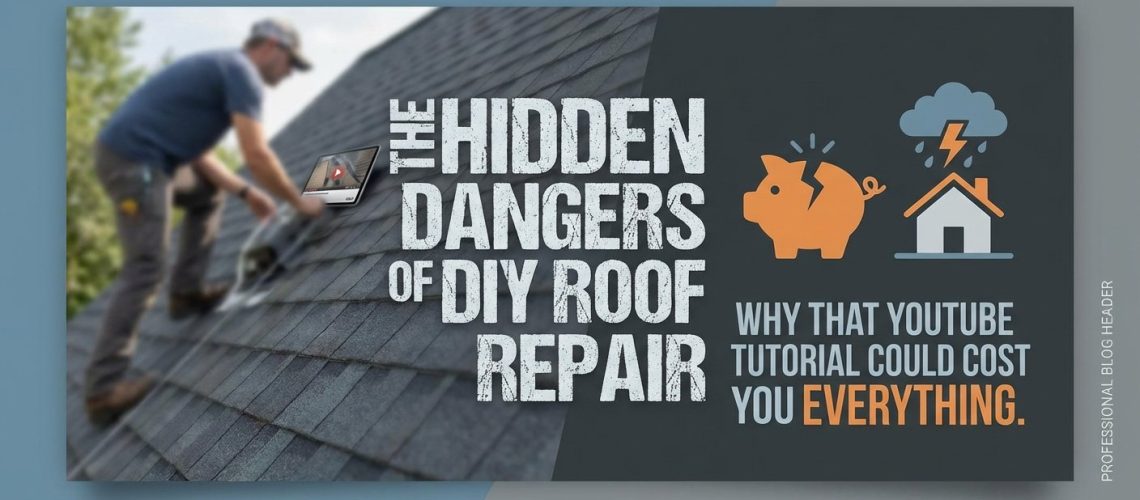
A Palm Beach County homeowner recently spent $847 on roofing materials after watching several YouTube tutorials on fixing his tile roof leak. Three months later, he called Mike McGilvary Roofing to repair the original leak—plus $12,400 in additional water damage his DIY attempt had caused by improperly routing water beneath the underlayment. What started as an attempt to save money became a financial disaster that also voided his roof warranty and complicated his insurance claim.
This scenario plays out across South Florida every month. The appeal of DIY roof repair is understandable: save money, immediate action, and dozens of confident online tutorials making it look straightforward. The reality? Roofing is one of the few home improvement areas where amateur attempts regularly create exponentially more damage than the original problem.
Why Roofing Is Different From Other DIY Projects
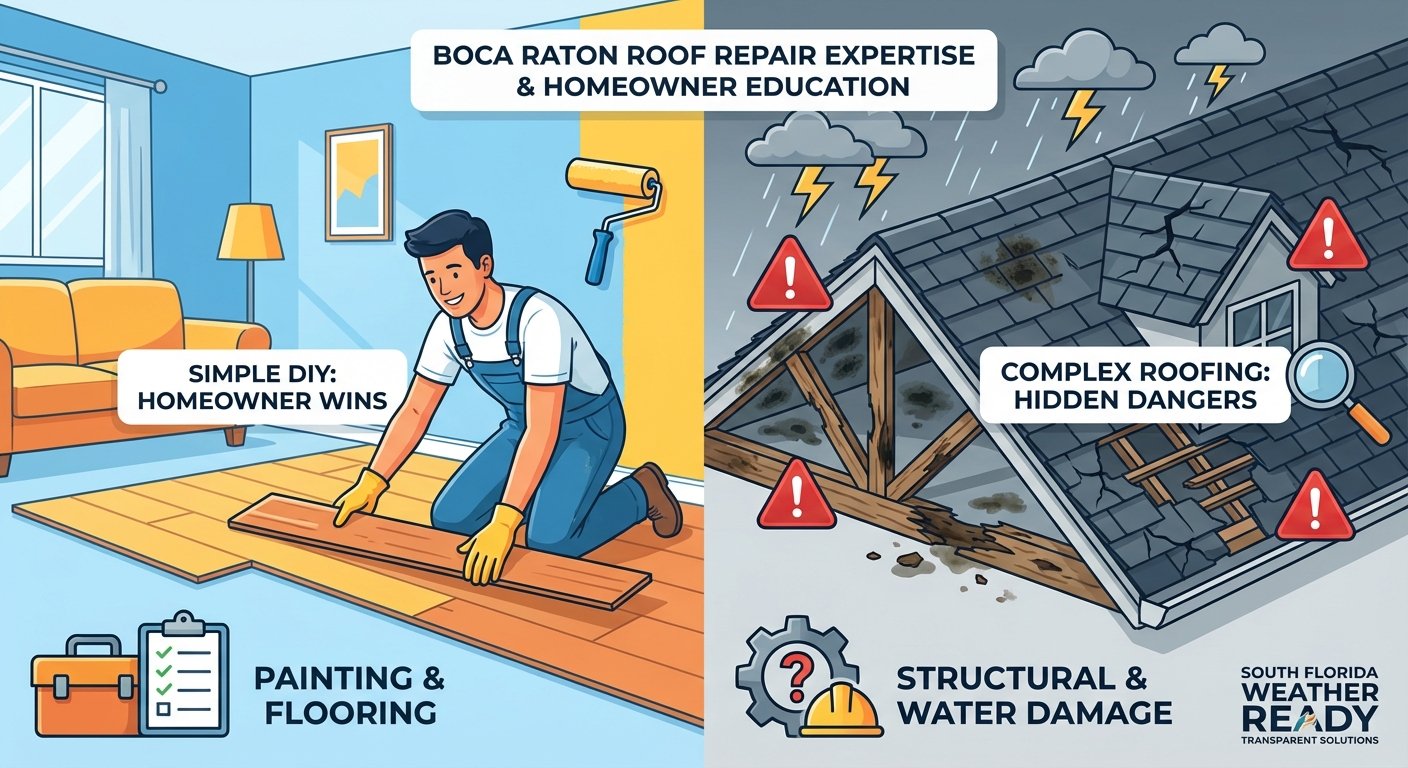
You can successfully install laminate flooring, paint cabinets, or replace a faucet with careful research and the right tools. Roofing operates under completely different rules that make DIY attempts uniquely dangerous.
The Invisible Nature of Roof Systems
When you see a leak stain on your ceiling, you’re witnessing the end result of a failure that likely occurred 10-15 feet away from where water finally penetrated. Water follows the path of least resistance—traveling along rafters, under underlayment, across decking—before finding an entry point into your home. That visible brown spot provides almost no information about where the actual failure exists.
Professional roofers spend years learning to trace water intrusion backward to its source. Mike McGilvary personally inspects every project specifically because this diagnostic skill separates competent repairs from expensive failures. A DIY approach typically involves sealing the obvious problem area—which may be nowhere near the actual failure point.
The Layered System Problem
Your roof isn’t a single surface; it’s an integrated system of interdependent layers:
- Decking: The structural foundation (typically plywood or OSB)
- Underlayment: The waterproof barrier (traditionally felt paper, now synthetic materials)
- Valley metals: Channeling systems directing water flow
- Flashing: Waterproof transitions at all penetrations and intersections
- Visible roofing material: Tiles, shingles, or metal
Each layer must integrate properly with adjacent layers. A seemingly minor mistake—like driving a fastener through valley metal or creating an underlayment seam that directs water inward—can compromise the entire system. These mistakes remain invisible until significant damage occurs.
The Most Common DIY Roof Repair Mistakes
Misdiagnosing the Problem Source
A Boca Raton homeowner recently attempted to repair what appeared to be failing roof tiles near a second-story bathroom leak. He purchased matching tiles, carefully removed the cracked ones, and installed replacements with proper sealant. The leak continued. When Mike McGilvary Roofing performed a comprehensive inspection, the actual problem was a deteriorated plumbing boot around the vent stack eight feet away—invisible from ground level and unrelated to the tiles he’d replaced.
The cost of misdiagnosis extends beyond wasted materials. Every day a leak continues causes progressive damage to decking, insulation, framing, drywall, and electrical systems. What could have been a $350 boot replacement became a $4,200 project addressing water damage that accumulated during his repair attempts.
Improper Fastening and Attachment
South Florida operates under the High Velocity Hurricane Zone (HVHZ) building code—the strictest wind resistance standards in the continental United States. Post-Hurricane Andrew requirements mandate specific fastening patterns, adhesive applications, and attachment methods designed to keep roofing materials in place during 180+ mph wind events.
DIY roof repair attempts consistently fail to meet these standards. Common mistakes include:
- Using incorrect fastener types or lengths
- Improper fastener placement (too close to tile edges, missing rafters)
- Inadequate foam adhesive application on tile undersides
- Skipping required mechanical attachments entirely
- Using incompatible materials that accelerate corrosion
These failures may hold under normal conditions but become catastrophic during tropical storms. A single improperly attached tile can become a projectile that damages the roof further or breaks through windows, allowing water intrusion throughout the home.
Breaking the Waterproof Seal
The most expensive DIY roof repair mistakes involve inadvertently creating new water entry points while attempting to fix existing ones. This happens when homeowners:
Drive fasteners through valley metals: Valley metals channel tremendous water volume during South Florida’s afternoon thunderstorms. A single fastener penetration creates a leak point that may not manifest for months—until heavy rain finally finds the hole and pours directly onto decking below.
Compromise underlayment integrity: Walking on aged tile roofs without understanding load distribution breaks tiles and tears underlayment. Each tear becomes a permanent vulnerability. Professional roofers use walking pads, understand tile strength variation, and know precisely where structural support exists beneath the surface.
Create reverse-lapping seams: When patching underlayment or flashing, proper overlap direction is critical. Water must flow over the top layer onto the lower layer—never the reverse. DIY attempts frequently create seams that look correct but actually channel water beneath the waterproof barrier.
Using Inappropriate Materials
The roofing industry uses highly specialized materials engineered for specific applications and Florida’s brutal climate. Big box stores stock consumer-grade products that appear similar but lack the performance characteristics professional materials provide.
Mike McGilvary Roofing recently corrected a DIY repair where the homeowner used standard exterior caulk around roof penetrations instead of proper roofing sealant. Within six months, UV exposure and thermal cycling had caused complete failure. Professional roofing sealants contain UV inhibitors and remain flexible across temperature ranges from 40°F to 180°F—the surface temperature differential South Florida roofs experience.
The Safety Realities Nobody Discusses
Fall Statistics You Should Know
According to the Occupational Safety and Health Administration (OSHA), falls from roofs account for one-third of all construction fatalities. These aren’t just professional roofers working on commercial high-rises—they include homeowners attempting repairs on single-story residential roofs.
A Palm Beach Gardens resident suffered permanent spinal injuries falling from his single-story tile roof while attempting a valley repair. The pitch was only 4/12—considered relatively moderate—but tile surfaces become extraordinarily slippery with morning dew, a reality he discovered catastrophically. His medical bills exceeded $180,000, and he never regained full mobility.
Tile Roofs Are Deceptively Dangerous
Concrete and clay tiles create unique fall hazards that differ from shingle roofs. Tiles break unexpectedly under foot traffic, particularly on roofs over 15 years old where UV exposure has degraded material strength. When a tile breaks, you’re suddenly standing on underlayment—which may also tear—leading to a fall through to the attic or complete roof penetration.
Professional roofing crews use specialized safety equipment including roof anchors, personal fall arrest systems, and tile walking pads that distribute weight. They also carry workers’ compensation insurance covering medical costs if accidents occur. Homeowners attempting DIY roof repair have none of these protections.
Heat Exposure and Physical Demands
South Florida roof surfaces regularly reach 160-180°F during summer months. The physical demands of roofing work in these conditions exceed what most homeowners anticipate. Heat exhaustion, dehydration, and heat stroke are legitimate dangers that professional crews manage through training, hydration protocols, and work scheduling.
The Financial False Economy
When DIY Costs More Than Professional Repair
The initial calculation seems straightforward: professional repair costs $2,500, materials cost $400, therefore DIY saves $2,100. This math ignores several expensive realities:
Tool and equipment costs: Professional roofing requires specialized tools many homeowners don’t own—tile cutters, roofing nailers, safety equipment, ladders rated for roof access. These purchases can exceed $1,000.
Material waste and errors: Professional roofers order precise quantities and have relationships allowing material returns. Homeowners typically over-purchase to avoid mid-project shortages, then cannot return specialty cut or modified materials.
Time value: A repair Mike McGilvary Roofing completes in four hours may take a homeowner two full weekends, assuming everything goes correctly.
Correction costs: When DIY attempts fail or create additional problems, professional correction costs often exceed what the original proper repair would have cost—sometimes by multiples.
Insurance and Warranty Implications
Most roofing warranties explicitly exclude coverage for homeowner modifications or repairs. That $15,000 roof you installed three years ago? The warranty becomes void the moment you perform DIY repairs, even if your work had nothing to do with future failures.
Insurance implications are equally serious. Florida’s challenging property insurance market has made carriers increasingly aggressive about claim denials. When adjusters discover DIY roof repairs contributed to water damage—or that improper repairs masked ongoing problems—they routinely deny claims that would otherwise be covered.
When Professional Help Is Non-Negotiable
Certain roof repair situations should never involve DIY attempts:
- Any leak of unknown origin: If you cannot definitively identify the failure point, diagnosis requires professional expertise
- Structural repairs: Decking replacement, rafter repairs, or truss issues require engineering knowledge and proper techniques
- Valley repairs: Valleys handle concentrated water flow and require precise installation
- Flashing work: All penetrations (chimneys, vents, skylights) need properly integrated flashing systems
- Multi-layer problems: When underlayment, decking, or multiple roof components need attention
- Insurance claim repairs: Improper repairs can void claims or create documentation problems
The Mike McGilvary Alternative: Honest Assessment
Mike McGilvary Roofing built five decades of reputation on a simple principle: recommend what homeowners actually need, not what generates maximum profit. When you call for a roof inspection, you receive an honest assessment of whether repair, rebuild, or replacement makes sense for your specific situation.
Many Palm Beach County homeowners discover their roof needs far less work than other contractors quoted. A recent Wellington client received a $42,000 replacement quote from a competitor for his 22-year-old tile roof. Mike McGilvary’s inspection revealed the tiles themselves remained sound—only valley metals and partial underlayment needed replacement. The strategic rebuild cost $6,800 and came with a 5-year certification satisfying his insurance requirements.
This repair-first philosophy means sometimes recommending a $500 fix instead of a $5,000 project. It’s not the approach that maximizes short-term revenue, but it’s why Mike McGilvary Roofing maintains a 5.0-star rating across 400+ Google reviews and why clients call back when they eventually need major work.
What Actually Constitutes Reasonable Homeowner Maintenance
While structural repairs should remain with professionals, reasonable maintenance includes:
- Keeping gutters clear of debris
- Trimming branches that overhang the roof
- Visual inspections from ground level after storms
- Documenting roof condition with photographs for insurance purposes
- Scheduling professional inspections every 2-3 years
These activities maintain roof health without creating the risks DIY roof repair introduces.
Making the Right Decision for Your Roof
The appeal of DIY roof repair is understandable in an era of rising costs and abundant online information. But roofing remains one of the few home improvement areas where amateur attempts regularly create exponentially worse problems than originally existed.
Your roof protects everything beneath it—your family, your possessions, your largest financial investment. The hidden dangers of DIY roof repair extend beyond immediate safety risks to include long-term structural damage, voided warranties, insurance complications, and repair costs that dwarf what professional service would have cost initially.
If you’re experiencing roof problems in Palm Beach County, Mike McGilvary Roofing offers free inspections with honest assessments of what you actually need. No pressure for unnecessary replacements, no inflated quotes, just straightforward evaluation from a contractor who’s been serving South Florida homeowners since 1974.
Call Mike McGilvary Roofing at [phone number] or visit our website to schedule your free roof inspection. We’re available 24/7 for emergency situations and provide the transparent, affordable service Palm Beach County homeowners have trusted for over 50 years. Let us show you the difference honest roofing makes—and why that YouTube tutorial isn’t worth the risks.