
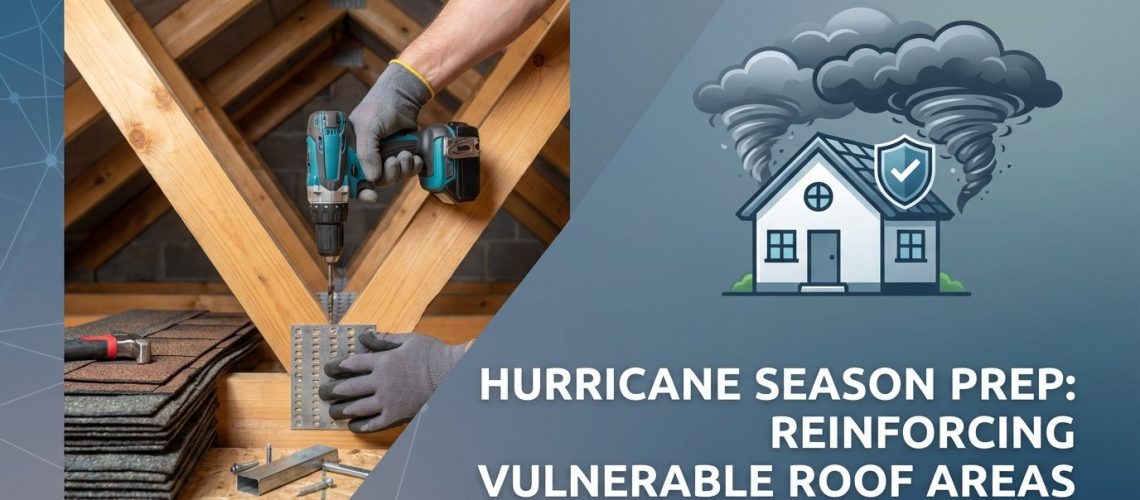
Your roof is your home’s first line of defense against Florida’s hurricane-force winds, torrential rain, and flying debris. But here’s what most homeowners don’t realize: complete roof failure during hurricanes rarely happens to structurally sound roofs. Instead, hurricanes exploit specific vulnerable areas—valleys, roof-to-wall connections, penetrations, and aging flashing—turning small weaknesses into catastrophic water damage and progressive structural failure.
The good news? Strategic hurricane roof preparation focusing on these vulnerable areas costs a fraction of emergency repairs after the storm. A $3,000-$8,000 targeted reinforcement investment now can prevent $50,000+ in interior damage, insurance headaches, and emergency tarping at premium post-storm pricing.
Understanding How Hurricanes Actually Damage Roofs
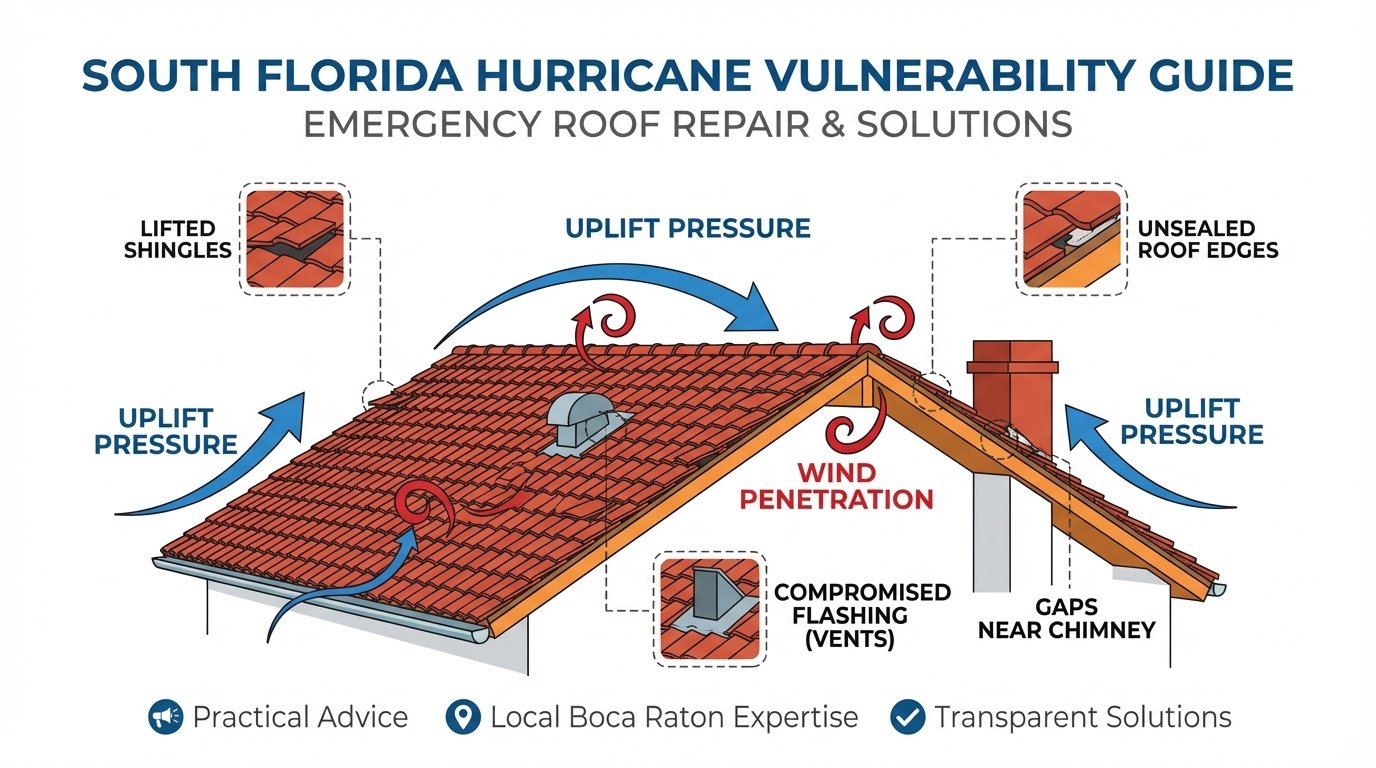
Hollywood shows hurricanes ripping entire roofs off houses, but that’s not how most hurricane damage occurs in Palm Beach County. Modern building codes since Hurricane Andrew have dramatically improved structural attachments. Instead, hurricanes find and exploit existing vulnerabilities through a predictable progression:
Stage 1: Wind Uplift at Edges and Penetrations
Hurricane winds create enormous uplift pressure, particularly at roof edges, gables, and around penetrations like vents and chimneys. Loose or improperly fastened tiles lift first, creating entry points for wind-driven rain.
Stage 2: Water Infiltration Through Compromised Barriers
Once protective tile or shingles are compromised, wind-driven rain attacks underlayment and flashing. Aging underlayment (common in 15+ year roofs) fails quickly under pressure, allowing water to reach decking and eventually your interior.
Stage 3: Progressive Failure
Water penetration leads to decking deterioration, which compromises fastener holding power, which leads to more tiles lifting, which accelerates water intrusion. This cascade effect is why small vulnerabilities become major damage during extended hurricane exposure.
Understanding this progression reveals exactly where to focus hurricane proof roof repairs for maximum protection.
The Six Most Vulnerable Roof Areas Requiring Hurricane Reinforcement
1. Roof Valleys: Your Highest-Risk Zone
Valleys channel tremendous water volume and experience concentrated wind pressure from multiple roof planes meeting. Valley metal in Palm Beach County roofs typically shows significant deterioration after 15-20 years due to constant water exposure and thermal cycling.
Hurricane vulnerability signs:
- Visible rust or corrosion on metal valleys
- Separation between valley metal and adjacent tiles
- Granule accumulation indicating accelerated wear
- Previous leak evidence in valley areas
- Metal valleys installed before 2000 (likely inadequate gauge)
Reinforcement approach: Complete valley metal replacement with heavier-gauge material, properly integrated underlayment extending 18″ beyond valley centerline, and tile reset with upgraded fastening. Cost range: $2,000-$4,500 depending on valley length and accessibility.
2. Roof-to-Wall Connections and Step Flashing
Where your roof meets vertical walls—dormers, second stories, chimneys—water has natural entry opportunities. Step flashing must create a weathertight seal while allowing for thermal movement. This area often receives minimal attention during original construction and deteriorates invisibly behind tiles or shingles.
Common failure points:
- Improperly integrated flashing that relies solely on sealant
- Deteriorated sealant at flashing edges (5-7 year lifespan in Florida sun)
- Flashing installed over (rather than under) wall cladding
- Missing or inadequate kick-out flashing at wall terminations
Reinforcement approach: Complete flashing reconstruction following current best practices, with proper layering sequence, mechanical fastening, and high-quality sealants rated for Florida UV exposure. Cost: $800-$2,500 per wall connection.
3. Penetrations: Vents, Pipes, and Skylights
Every roof penetration is a potential water entry point. Plumbing vents, bathroom exhaust vents, attic ventilation, and skylights all require specialized flashing and sealing. Rubber pipe boots—standard on most Florida homes—deteriorate rapidly in UV exposure, typically failing in 7-10 years.
Strengthen roof for hurricane checklist:
- Replace all rubber boots with longer-lasting materials
- Verify proper flashing integration on all penetrations
- Seal around penetration flashing with premium polyurethane sealants
- Consider adding storm collars to vent pipes for additional protection
- Inspect and reseal skylight flashing (major vulnerability in tile roofs)
This targeted work typically costs $300-$800 depending on penetration count, but prevents the most common source of hurricane-related interior water damage.
4. Roof Edges and Fascia Connections
Hurricane winds create maximum uplift at roof perimeters. The first three feet of roofing from the edge experiences significantly higher wind pressure than field areas. Tiles or shingles with inadequate fastening in these zones lift first, creating progressive failure opportunities.
Edge reinforcement priorities:
- Verify every perimeter tile has mechanical fastening (code requires this; many older roofs lack it)
- Inspect drip edge and fascia metal for proper installation and condition
- Confirm underlayment extends fully under edge tiles with proper overlap
- Add foam closure strips under barrel or S-tiles to prevent wind-driven rain entry
Perimeter tile reinforcement costs $8-$15 per linear foot but provides outsized protection given this area’s vulnerability.
5. Ridge Caps and Hip Tiles
Elevated ridge and hip tiles experience the highest wind speeds on your roof. They also rely heavily on mortar or foam bedding that deteriorates over time. In tile roofs over 20 years old, loose ridge caps are nearly universal.
Hurricane-ready ridge reinforcement: Remove existing ridge/hip tiles, install new underlayment over the peak, mechanically fasten tiles with code-compliant fasteners, and apply foam or mortar bedding. Modern installations use mechanical fastening as primary attachment with foam as secondary seal—older roofs often relied on mortar alone. Cost: $12-$22 per linear foot.
6. Aging Underlayment in Specific Sections
Here’s where Mike McGilvary Roofing’s rebuild philosophy becomes especially valuable for Florida hurricane roof prep. Your 20-25 year old tile roof doesn’t need complete replacement, but sections with deteriorated underlayment create serious vulnerability during hurricanes.
Think of your roof like a car approaching 30,000 miles. You don’t buy a new car—you replace the tires, change the oil, and address actual wear items. Similarly, you don’t replace a structurally sound tile roof when underlayment in your valleys and lower slopes has deteriorated while upper sections remain solid.
Section-specific rebuild approach:
- Identify sections with underlayment deterioration (usually south and west exposures, valleys, lower slopes)
- Carefully remove and inventory tiles from affected sections
- Replace damaged decking if moisture intrusion has occurred
- Install new synthetic underlayment to current standards
- Reinstall original tiles with upgraded fastening to current wind codes
- Replace damaged tiles and integrate new flashing as needed
This strategic approach costs $3,000-$8,000 for typical problem sections versus $40,000-$75,000 for unnecessary complete replacement. You get hurricane-ready protection at a fraction of the cost while preserving decades of remaining tile life.
Florida Hurricane Roof Prep: Timeline and Planning
Hurricane season officially runs June 1 through November 30, with peak activity August through October. But here’s the critical planning reality: you cannot effectively prepare your roof once a named storm enters the Gulf or approaches the Atlantic coast.
Optimal preparation timeline:
January-April (Ideal Window): Roofing contractors have maximum availability, materials are readily accessible, and you can schedule work at your convenience. This is when thoughtful homeowners address vulnerabilities identified during the previous season.
May (Last Reasonable Opportunity): Contractors begin booking up, but quality work remains possible. Material suppliers still maintain full inventory.
June-November (Hurricane Season): Once season begins, securing contractor availability becomes challenging. When named storms approach, getting any service becomes nearly impossible. Post-storm, emergency rates apply ($200-$300/hour is common), material costs spike, and quality contractors are booked months out.
The homeowners who fare best during hurricane season completed their storm damage prevention work during the calm months.
The Insurance Factor: How Hurricane Preparation Affects Coverage
Florida’s property insurance crisis makes hurricane roof preparation more valuable than ever. Many carriers now require roofs under 15 years for new policies, and roof age heavily influences premium pricing and coverage availability.
Here’s where strategic reinforcement creates unexpected value: A comprehensive roof rebuild addressing vulnerable areas, documented with photos and invoices, can qualify for a 5-year roof certification. This certification satisfies insurance requirements at 20-40% the cost of complete replacement.
Mike McGilvary Roofing provides free roof inspections and 5-year certifications for qualifying roofs. We don’t push unnecessary replacements—we honestly assess your roof’s condition and identify the most cost-effective path to both hurricane readiness and insurance compliance.
What Hurricane Proof Roof Repairs Actually Cost
Transparent pricing helps homeowners make informed decisions. Here are realistic cost ranges for common hurricane preparation work in Palm Beach County:
- Valley metal replacement: $2,000-$4,500 (depending on length and accessibility)
- Complete flashing reconstruction: $800-$2,500 per wall connection
- Penetration sealing and boot replacement: $300-$800 for typical home
- Perimeter tile reinforcement: $8-$15 per linear foot
- Ridge cap replacement/reinforcement: $12-$22 per linear foot
- Section-specific underlayment rebuild: $3,000-$8,000 for problem areas
- Comprehensive vulnerability reinforcement package: $6,000-$15,000 depending on roof size and condition
Compare these investments to post-hurricane emergency repairs ($10,000-$50,000+), interior water damage remediation ($15,000-$75,000+), and temporary housing costs during repairs. Hurricane preparation isn’t an expense—it’s insurance your insurance company doesn’t provide.
Why Mike McGilvary Roofing Takes a Different Approach
The roofing industry has a profit incentive problem. A $50,000 roof replacement generates far more revenue than a $6,000 targeted reinforcement. Most contractors will look at your 22-year-old tile roof and immediately quote full replacement.
Mike McGilvary Roofing operates differently. Since 1974, we’ve built our reputation on honesty—telling you what you actually need, not what generates maximum profit. Mike personally reviews every project, and we don’t sell you work your roof doesn’t require.
Our 5.0-star rating across 400+ Google reviews reflects this philosophy. So does our A+ BBB accreditation and top-10% BuildZoom ranking among Florida’s 191,428+ contractors. We’ve maintained Florida Contractor License CCC1331721 for decades because we treat your home the way we’d treat our own.
When we inspect your roof for hurricane vulnerabilities, you’ll receive an honest assessment: what needs immediate attention, what can wait, and what doesn’t need touching. If your roof needs complete replacement, we’ll tell you. If strategic reinforcement provides adequate protection, we’ll tell you that instead—even though it means less revenue for us.
Take Action Before the Storm
Hurricane preparation separates successful homeowners from those facing insurance battles and contractor shortages after the storm. The vulnerabilities in your roof won’t announce themselves—they’ll simply fail when Category 3 winds and 12 inches of rain test every weakness.
Mike McGilvary Roofing offers free roof inspections throughout Palm Beach County and surrounding South Florida communities. We’ll identify your specific vulnerabilities, provide transparent pricing for reinforcement options, and help you make informed decisions about hurricane preparation that fit your budget.
We’re available 24/7 for emergencies, but the time to address hurricane vulnerabilities is now—not when a named storm appears in the forecast.
Call Mike McGilvary Roofing today for your free inspection. Let’s identify and reinforce your roof’s vulnerable areas before hurricane season tests them. With 50+ years serving South Florida, we understand exactly what your roof needs to weather the storms ahead—and we’ll give you an honest answer, not a sales pitch.