
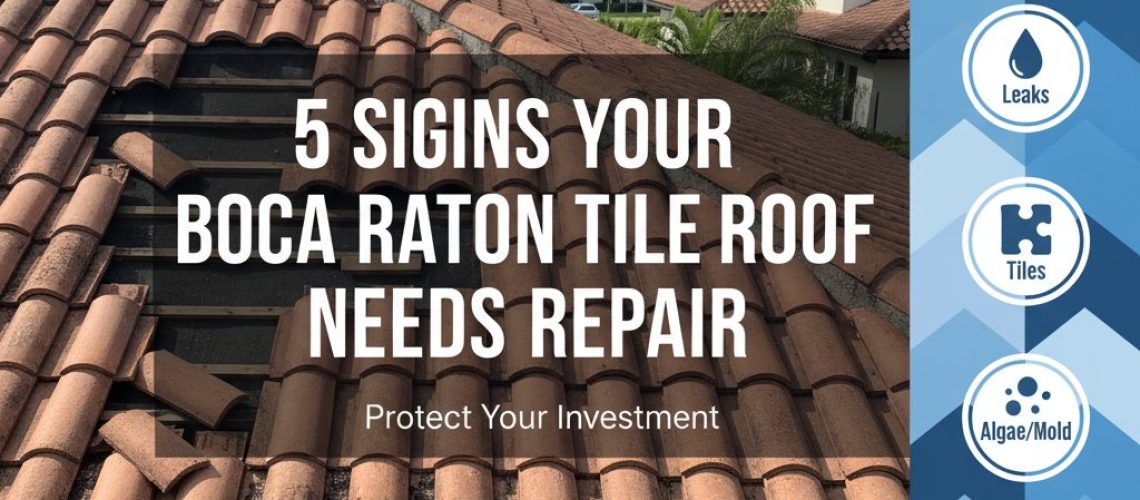
Your tile roof represents one of your most significant investments, and in Boca Raton’s exclusive neighborhoods—from Mizner-inspired estates to Mediterranean-style homes in Royal Palm Yacht & Country Club—these roofs define architectural character while protecting your property. Yet even the most meticulously maintained tile roofs eventually show warning signs that demand immediate attention. The difference between catching these issues early and waiting too long can mean the difference between a $3,500 targeted repair and a $50,000 emergency replacement.
Since 1974, Mike McGilvary Roofing has specialized in honest, repair-first solutions for Boca Raton homeowners. We’ve built our reputation by telling property owners what they actually need—not what generates the biggest invoice. When we inspect a roof, we’re looking for specific, fixable problems that can extend your roof’s life for years or even decades, not manufacturing reasons for unnecessary replacement.
Sign #1: Visible Water Stains on Ceilings or Walls
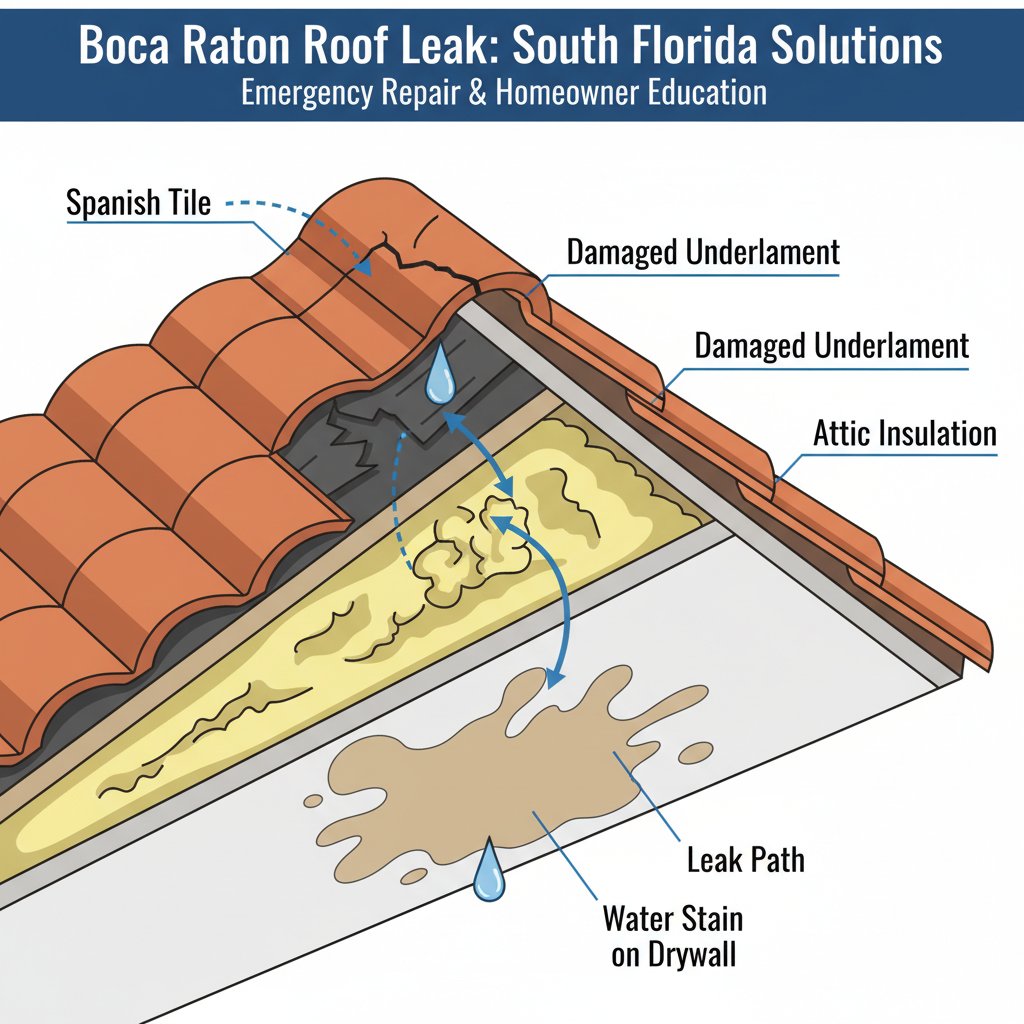
Water stains represent your roof’s clearest distress signal. These discolorations—typically brown, yellow, or copper-colored—appear on interior ceilings or upper walls when moisture penetrates your roof system and migrates through insulation and drywall.
In Boca Raton’s tile roof systems, water stains usually indicate one of several specific failures:
- Valley metal deterioration: The metal channels that direct water between roof planes corrode after 20-25 years, allowing water to seep beneath tiles
- Underlayment breakdown: The waterproof barrier beneath tiles degrades from heat exposure, creating vulnerable spots
- Flashing separation: Metal seals around chimneys, vents, and skylights pull away from mounting surfaces
- Compromised penetration boots: Rubber seals around plumbing vents crack and split from UV exposure
Here’s what Boca Raton homeowners must understand: a water stain doesn’t mean you need a new roof. It means you have a specific breach point that requires targeted tile roof repair. We recently worked with a homeowner in Woodfield Country Club who received three quotes for complete replacement ($42,000-$58,000) because of ceiling stains in one bedroom. The actual problem? Deteriorated valley metal in a 200-square-foot section. We rebuilt that valley, replaced underlayment in the affected area, and reinstalled the original tiles for $4,800. That’s the repair-first philosophy in action.
The critical factor is timing. Water damage accelerates exponentially. A small underlayment breach that might cost $2,500 to repair today becomes a $12,000 decking replacement project in six months when moisture reaches the plywood substrate and causes rot.
Sign #2: Broken, Cracked, or Missing Tiles
Tile damage occurs from multiple sources in Boca Raton: falling palm fronds, maintenance workers walking improperly, thermal stress from extreme temperature fluctuations, and occasionally from impact during tropical systems. While concrete tile roof repair and clay tile roof repair follow similar principles, the replacement approach differs slightly based on material characteristics.
Individual tile damage typically manifests in three ways:
Complete tile absence: Tiles blow off during wind events or get dislodged during maintenance work. The exposed underlayment becomes immediately vulnerable to UV degradation and water penetration. A single missing tile can compromise a 3-4 square foot area of underlayment within months.
Visible cracks: Hairline cracks expand with thermal cycling (Boca Raton roof surfaces routinely exceed 160°F on summer afternoons, then cool to 75°F overnight). Cracked tiles channel water directly to underlayment rather than shedding it properly.
Corner chips and edge damage: While seemingly minor, edge damage changes how tiles interlock, creating gaps in the water-shedding system. Multiple damaged tiles in proximity create vulnerable zones where wind-driven rain can penetrate.
The good news: broken tile replacement typically costs $50-$150 per tile including labor for concrete tiles, and $100-$250 for clay tiles depending on profile and availability. Mike McGilvary Roofing maintains relationships with tile suppliers throughout South Florida, giving us access to discontinued profiles and custom colors that match Boca Raton’s architectural requirements—critical when dealing with HOA architectural review boards.
We recently completed a tile roof repair project for a homeowner in Boca West where a tree service damaged 23 tiles during palm tree trimming. Rather than the $35,000 “roof replacement” another contractor recommended, we sourced matching tiles, replaced the damaged units, and inspected the entire roof system for $3,400. The homeowner received a 5-year certification for insurance purposes, satisfying their carrier’s requirements without the unnecessary expense of full replacement.
Sign #3: Granular Debris in Gutters and Downspouts
This warning sign confuses many Boca Raton homeowners because it seems contradictory—tile roofs don’t have granules like asphalt shingles. However, both concrete and clay tiles develop surface erosion over time, particularly in South Florida’s intense UV exposure combined with seasonal heavy rainfall.
What you’re seeing in gutters represents tile surface degradation:
Concrete tile erosion: Concrete tiles consist of Portland cement, sand aggregate, and pigment. After 15-20 years of Florida sun exposure, surface cement begins breaking down. The sandy residue accumulates in valleys and washes into gutters. While surface erosion doesn’t immediately compromise the tile’s waterproofing function, it indicates the tile has entered its later service life and other components (underlayment, valley metals, flashings) likely need attention.
Clay tile spalling: Clay tiles can develop surface flaking when water penetrates microscopic cracks, freezes during rare cold snaps (yes, even in Boca Raton we occasionally see temperatures near freezing), and causes the surface layer to separate. The resulting fragments appear as reddish-orange chips in gutters.
When we find significant granular debris during inspections, we’re not rushing to recommend replacement. Instead, we’re evaluating whether the tiles themselves have sufficient remaining service life (they almost always do) while identifying the actual vulnerable components—typically underlayment, valley metals, and flashings that have deteriorated while the tiles remain structurally sound.
This distinction matters tremendously for Boca Raton homeowners facing insurance pressures. A tile roof showing surface erosion can still receive a 5-year certification after strategic rebuilding of underlayment and related components, satisfying insurance requirements at a fraction of replacement cost.
Sign #4: Visible Light Through Roof Decking from Attic
If you can see daylight through your roof decking from the attic space, you have an active breach requiring immediate tile roof leak repair. This scenario represents complete system failure at specific points—not just tile damage, but compromised underlayment and potentially damaged decking.
Common causes in Boca Raton tile roof systems include:
- Penetration seal failure: Areas around roof-mounted air conditioning equipment, attic ventilation fans, or satellite dishes where improper flashing installation created immediate weak points
- Valley metal complete corrosion: When valley metals rust through entirely, creating holes that allow direct water entry and light visibility
- Ridge cap displacement: High wind events can lift ridge caps (the tiles covering the roof peak), exposing the ridge board and creating a continuous breach line
- Tile batten deterioration: The wooden strips that support tile installation can rot from prolonged moisture exposure, causing tiles to sag and separate
Visible light means visible water entry during rain events. This situation demands immediate professional evaluation from a qualified tile roof contractor in Boca Raton who can assess not just the breach point, but the extent of consequential damage to decking, insulation, and structural framing.
We worked with a homeowner in Broken Sound whose attic inspection revealed light coming through near a plumbing vent stack. Two contractors had quoted $48,000-$52,000 for complete replacement, citing “widespread failure.” Our inspection found the problem isolated to improper flashing installation around that single penetration, which had allowed 3-4 years of minor water intrusion. We replaced the damaged decking section (approximately 16 square feet), rebuilt the flashing properly, replaced underlayment in the affected zone, and reinstalled tiles. Total investment: $2,800. The surrounding roof system remained sound with decades of service life remaining.
That’s not cutting corners—that’s honest roofing. You don’t buy a new car when you need new tires. You don’t replace a roof when you need a targeted repair.
Sign #5: Sudden Spike in Energy Costs
This subtle indicator surprises many Boca Raton homeowners, but roof system compromise directly impacts HVAC efficiency. When underlayment deteriorates, attic temperatures increase dramatically. A properly functioning tile roof system with intact underlayment maintains attic temperatures 15-25°F cooler than outdoor ambient temperature through ventilation and radiant barrier effects. When underlayment fails, that temperature differential collapses.
The consequence: your air conditioning system runs longer cycles to maintain interior temperature, driving energy consumption upward. A 20-25% increase in summer cooling costs often indicates roof system degradation.
Mike McGilvary Roofing conducts thorough attic inspections specifically looking for this issue. We use infrared temperature readings to identify hot spots indicating underlayment failure or inadequate ventilation. These problems are eminently fixable through section-specific underlayment replacement—the roof rebuild approach we pioneered in Palm Beach County.
A Boca Pointe homeowner contacted us after their summer electric bills jumped from $380-$420 to $580-$650 monthly. Their 22-year-old concrete tile roof looked fine from the ground. Our inspection revealed underlayment failure across approximately 40% of the roof surface—the felt paper had essentially disintegrated from decades of heat exposure. Rather than full replacement, we systematically rebuilt those sections: carefully removed and cataloged tiles, installed new synthetic underlayment rated for Florida conditions, and reinstalled the original tiles with proper fastening to current wind codes. Investment: $12,500. Their next summer’s bills returned to the $390-$440 range, and they received a 5-year certification for their insurance carrier.
The Insurance Consideration: Why Repairs Matter More Than Ever
Florida’s property insurance crisis has transformed roof repair decision-making. Many carriers now require roofs under 15 years old for new policies, and existing policyholders face non-renewal when roofs exceed certain age thresholds. The industry’s solution—demanding full replacement—ignores a crucial fact: properly rebuilt tile roofs can receive 5-year certifications regardless of tile age.
Mike McGilvary Roofing (Florida Contractor License CCC1331721) provides free roof inspections and 5-year certifications when roof systems meet specific criteria. A strategic rebuild addressing underlayment, valley metals, flashings, and penetration seals can satisfy insurance requirements at 20-40% the cost of complete replacement. This matters tremendously in Boca Raton, where average tile roof replacement costs $45,000-$75,000 depending on home size and tile specifications.
Why the Repair-First Philosophy Protects Boca Raton Homeowners
The roofing industry has a fundamental conflict of interest: contractors generate far more revenue from $50,000 replacements than $4,000 repairs. This creates enormous pressure to recommend replacement for roofs that need strategic component rebuilding.
Mike McGilvary Roofing exists to provide honest alternatives. When we inspect your tile roof, we’re identifying actual problems and their most cost-effective solutions. Sometimes that means replacement—truly failed roof systems beyond economical repair do exist. But in our 50+ years serving Palm Beach County, we’ve found that 60-70% of roofs quoted for “necessary replacement” by other contractors actually need targeted repairs addressing specific component failures while preserving sound materials.
This approach has earned us a 5.0-star rating across 400+ Google reviews, BBB A+ accreditation, and a BuildZoom score of 103/100 (top 10% of nearly 200,000 Florida contractors). Boca Raton homeowners trust us because we tell them what they need—not what generates the biggest invoice.
Schedule Your Free Inspection Today
If you’ve noticed any of these five warning signs, your tile roof is communicating that it needs attention. The question isn’t whether to address the problem—ignoring roof issues in South Florida’s climate inevitably leads to exponentially more expensive damage. The question is finding a tile roof contractor in Boca Raton who will give you honest guidance about your most cost-effective options.
Mike McGilvary Roofing provides free, no-obligation roof inspections throughout Boca Raton and surrounding Palm Beach County communities. We’ll evaluate your entire roof system, identify specific issues, explain your options clearly, and provide transparent pricing for recommended repairs. If your roof genuinely needs replacement, we’ll tell you. If targeted tile roof repair can extend your roof’s life for years at a fraction of replacement cost, we’ll tell you that too.
We’re available 24/7 for emergency situations and typically schedule non-emergency inspections within 48 hours. Contact Mike McGilvary Roofing today at our Lake Worth office, and let’s have an honest conversation about your roof’s actual needs. You deserve transparency, expertise, and options—not a sales pitch for unnecessary replacement.