
Not every roof leak requires dropping everything and calling emergency services, but certain warning signs separate minor nuisances from situations that can cause catastrophic damage within hours. Understanding this difference can save you thousands of dollars in water damage, mold remediation, and structural repairs—or prevent unnecessary panic over issues that can wait until Monday morning.
After helping Palm Beach County homeowners address roof emergencies for over 50 years, we’ve seen the same pattern: homeowners who recognize serious warning signs and act quickly typically spend $2,000-$5,000 on repairs, while those who delay often face $15,000-$40,000 in combined roofing and interior damage restoration.
Here are the seven signs that your roof leak demands immediate professional attention.
1. Active Water Dripping During or Immediately After Rain
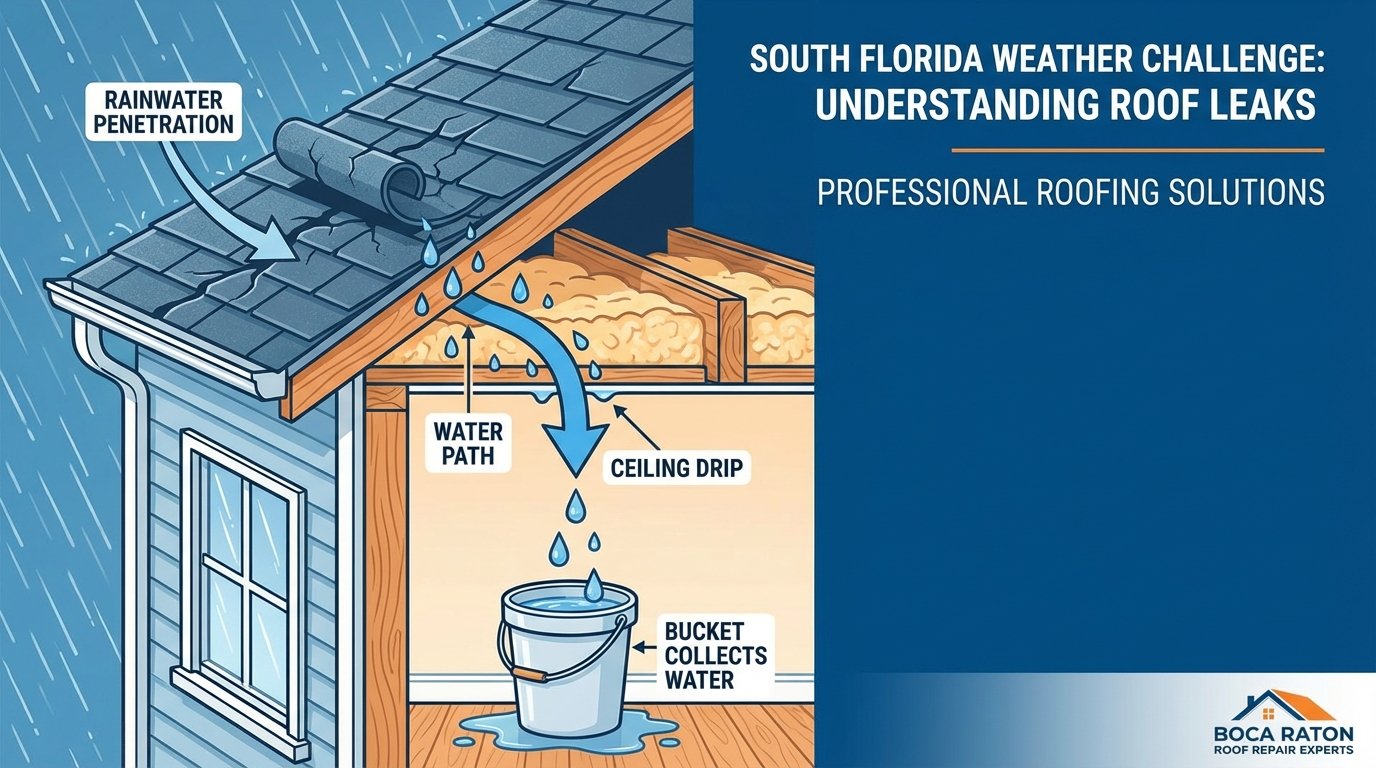
If you’re watching water drip from your ceiling during a rainstorm, you have an active roof leak that requires immediate assessment. This isn’t about a few drops appearing hours later as trapped moisture works through insulation—it’s about real-time water intrusion.
Why This Matters
Active leaking indicates a complete breach in your roof system. Water isn’t just touching your underlayment or finding a tiny gap—it’s flowing freely through multiple failed layers. Every minute of continued exposure allows water to:
- Saturate ceiling insulation, destroying its R-value and creating replacement needs
- Soak ceiling drywall or plaster, compromising structural integrity
- Run down wall cavities, affecting areas far from the visible ceiling stain
- Pool in concealed spaces where mold can establish within 24-48 hours
South Florida’s heavy rain events can dump 2-4 inches in an hour during summer thunderstorms. An active leak during one of these downpours might introduce 10-20 gallons of water into your ceiling cavity in a single afternoon.
Immediate Action Steps
Place containers to catch water and protect belongings, but don’t assume this solves the problem. Contact a roofing professional immediately—even if it’s still raining. Mike McGilvary Roofing provides 24/7 emergency response because we understand that documenting the active leak source while it’s happening makes repairs more accurate and cost-effective.
2. Multiple Leak Points Appearing Simultaneously
Discovering three, four, or more separate leak locations during the same rain event signals systemic roof failure rather than isolated damage. This pattern suggests widespread underlayment deterioration, extensive storm damage, or fundamental structural issues.
Multiple simultaneous leaks often indicate that your roof’s secondary water barrier—the underlayment beneath tiles or shingles—has degraded across large sections. In Palm Beach County’s tile roof market, we frequently see 20-25 year old roofs where the original felt underlayment has decomposed while the tiles themselves remain structurally sound.
The Rebuild Solution
Here’s where honest roofing advice saves homeowners tens of thousands of dollars: Multiple leaks don’t automatically mean complete replacement. You don’t buy a new car when multiple systems need service—you address what’s actually failing.
A targeted roof rebuild addressing the failed underlayment while preserving your tile typically costs $8,000-$15,000 compared to $40,000-$65,000 for unnecessary complete replacement. We carefully remove tiles, install modern synthetic underlayment, and reset your existing tiles with proper fastening. This approach gives you decades more service life at a fraction of replacement cost.
3. Sagging or Bulging Ceiling Sections
If your ceiling shows visible sagging, bulging, or downward bowing—especially near a leak point—you’re looking at a roof leak emergency that could result in ceiling collapse.
Drywall and plaster ceilings aren’t designed to hold water. When ceiling materials absorb moisture, they become exponentially heavier while simultaneously losing structural strength. A 4×4 foot section of water-saturated drywall can weigh 100+ pounds, supported only by compromised fasteners and framing.
Collapse Risk Timeline
Ceiling collapse doesn’t require months of water exposure. During heavy rain events, we’ve documented ceiling failures within 3-6 hours of leak initiation. The warning signs progress rapidly:
- Hour 1-2: Ceiling staining appears, materials begin absorbing water
- Hour 3-4: Visible sagging or bulging develops as materials saturate
- Hour 5-6: Fastener failure and potential collapse as weight exceeds support capacity
If you observe any sagging, immediately clear the area below, move valuables and furniture, and contact emergency roofing services. Don’t attempt to “drain” bulging ceiling sections yourself—puncturing saturated drywall can trigger sudden collapse.
4. Water Stains Expanding Rapidly
Ceiling stains that visibly grow during a rain event—expanding from dinner-plate size to multiple feet across within hours—indicate aggressive water intrusion that won’t resolve on its own.
Small, stable stains from minor leaks might expand slowly over days or weeks as residual moisture migrates through ceiling materials. Rapidly expanding stains mean water is actively flowing, and the affected area represents only what’s visible—actual water infiltration likely extends far beyond the stain perimeter.
The Hidden Damage Factor
For every square foot of visible ceiling stain, approximately 3-5 square feet of insulation, framing, and concealed materials are typically affected. Water follows the path of least resistance, traveling along joists, through wall cavities, and across horizontal surfaces before finally appearing on your ceiling.
This is why rapid response matters. Stopping the leak source quickly limits the affected area, keeping repair costs manageable. A $3,500 valley metal replacement today prevents $18,000 in combined roofing and interior restoration next month.
5. Leaks Near Electrical Fixtures or Equipment
Any roof leak that produces water near electrical panels, ceiling fixtures, outlets, or appliances creates immediate fire and electrocution hazards requiring emergency response.
Water and electricity form a dangerous combination. Moisture infiltrating electrical boxes can cause:
- Short circuits leading to fire ignition
- Energized water creating electrocution risk for anyone touching affected surfaces
- Permanent damage to electrical systems requiring extensive rewiring
- Code violations that insurance companies may cite when denying claims
Safety Protocol
If you observe water near any electrical component, shut off power to affected circuits at your breaker panel. If water is actively dripping onto the electrical panel itself, contact an electrician to safely shut down power, then call emergency roofing services.
Don’t assume that “just a little moisture” near electrical components is acceptable. We’ve responded to situations where homeowners ignored small leaks above ceiling fans, only to experience electrical fires weeks later when corroded connections finally failed.
6. Leaks Following Severe Weather Events
Roof leaks appearing during or immediately after hurricanes, tropical storms, or severe thunderstorms require immediate professional assessment even if the water intrusion seems minor.
Storm-related leaks often indicate structural damage that’s not immediately apparent from the ground. High winds can:
- Lift and crack tiles without complete displacement
- Tear underlayment while leaving surface materials intact
- Damage flashing around penetrations
- Compromise valley metals through debris impact
- Create fractures in aging roof materials that were marginally functional before the storm
The Insurance Documentation Window
Florida homeowners have specific timeframes for reporting storm damage to insurance carriers. Immediate professional inspection serves two critical purposes: stopping additional damage and documenting conditions while causation is clear.
Waiting weeks to address a storm-related leak allows insurance adjusters to argue that subsequent damage resulted from maintenance neglect rather than the covered storm event. We provide same-day emergency inspections following severe weather specifically to protect homeowners’ insurance claim rights.
7. Musty Odors or Visible Mold Accompanying Leaks
If your roof leak comes with musty smells or visible mold growth, you’re dealing with water intrusion that’s been occurring longer than you realized—and the health implications demand urgent response.
Mold establishes quickly in South Florida’s humid climate. Ceiling cavities with moisture intrusion can develop active mold colonies within 24-48 hours. Once established, mold:
- Spreads rapidly through porous materials
- Creates airborne spore exposure affecting respiratory health
- Requires professional remediation costing $2,000-$8,000 for typical residential situations
- Complicates insurance claims as carriers distinguish “sudden” damage from “long-term” maintenance issues
The Hidden Leak Problem
Musty odors indicate that water has been infiltrating longer than surface evidence suggests. Many Palm Beach County homes have concealed slow leaks for months before visible ceiling stains appear—the entire time, moisture is accumulating in insulation, soaking framing, and creating ideal mold conditions.
These situations require comprehensive assessment beyond simple leak repair. We inspect the full extent of moisture damage, identify all affected materials, and provide honest guidance on what actually needs replacement versus what can be preserved and treated.
When “Immediate” Actually Means Immediate
The roofing industry tends to overuse “emergency” language to drive sales urgency. Let’s be clear about what genuinely requires after-hours or weekend response versus what can wait until normal business hours:
True Emergencies (Call 24/7 Services)
- Active water intrusion during ongoing rain
- Sagging or bulging ceilings
- Water near electrical components
- Storm damage with exposed roof deck
- Rapidly expanding leak affecting multiple rooms
Urgent But Can Wait Until Morning
- New stain discovered after rain has stopped
- Small stable leak with contained water collection
- Historic minor leak that suddenly worsened
- Musty odor without active dripping
Mike McGilvary Roofing offers 24/7 emergency availability because genuine emergencies do occur. We also provide honest assessment of whether your situation truly requires immediate response or can be appropriately scheduled for next-business-day service, saving you emergency service premiums when they’re not necessary.
The Cost of Delay Versus Immediate Action
Homeowners often hesitate to call for roof leak assessment, worried about service costs or concerned they’re overreacting. The financial reality strongly favors immediate professional evaluation:
Immediate Response Scenario: Valley metal failure identified and repaired within 24 hours of leak discovery. Cost: $3,200 for valley replacement. Interior damage: Minor ceiling stain requiring paint touch-up ($200-300). Total cost: $3,500.
Delayed Response Scenario: Same valley metal failure ignored for three weeks across multiple rain events. Resulting damage: Valley replacement ($3,200), ceiling drywall replacement in two rooms ($2,800), insulation replacement ($1,600), mold remediation ($3,500), repainting ($1,200). Total cost: $12,300.
The seven-day difference between “I should call someone” and actually scheduling service regularly creates $8,000-$15,000 in additional damage costs.
Your Roof Leak Action Plan
If you’re experiencing any of the seven warning signs described above, here’s your immediate action plan:
Step 1: Protect your interior. Move valuables, place containers to catch water, and document damage with photos.
Step 2: Assess electrical safety. If water is near any electrical component, shut off affected circuits.
Step 3: Contact professional roofing services immediately for true emergencies, or schedule next-business-day assessment for urgent but stable situations.
Step 4: Don’t attempt temporary repairs that might void insurance coverage or create liability issues with improper roof access.
Honest Roofing Assessment in Palm Beach County
Mike McGilvary Roofing has served Palm Beach County (family roofing roots dating to 1974) with a simple philosophy: tell homeowners what they actually need, not what generates the biggest invoice. When you contact us for roof leak assessment, you’ll receive:
- Honest evaluation of whether your situation requires immediate emergency response
- Clear explanation of leak source and required repairs
- Repair-first approach exploring targeted fixes before recommending replacement
- Transparent pricing with detailed scope documentation
- Direct owner involvement—Mike McGilvary personally oversees every project
We provide free roof inspections throughout Palm Beach County and surrounding South Florida communities. Our 5-year roof certifications help homeowners document their roof’s condition for insurance review while our targeted repair approach addresses actual problems without unnecessary expense.
Don’t let a manageable roof leak become a catastrophic damage event. Contact Mike McGilvary Roofing at your first sign of serious roof damage. With 24/7 emergency availability, Florida Contractor License CCC1331721, BBB A+ accreditation, and over 400 five-star Google reviews, we’re the honest roofing partner Palm Beach County homeowners trust when immediate attention actually matters.
Call us today for immediate roof leak assessment and discover the difference that 50+ years of integrity-focused roofing service makes.
Related from Mike McGilvary Roofing