
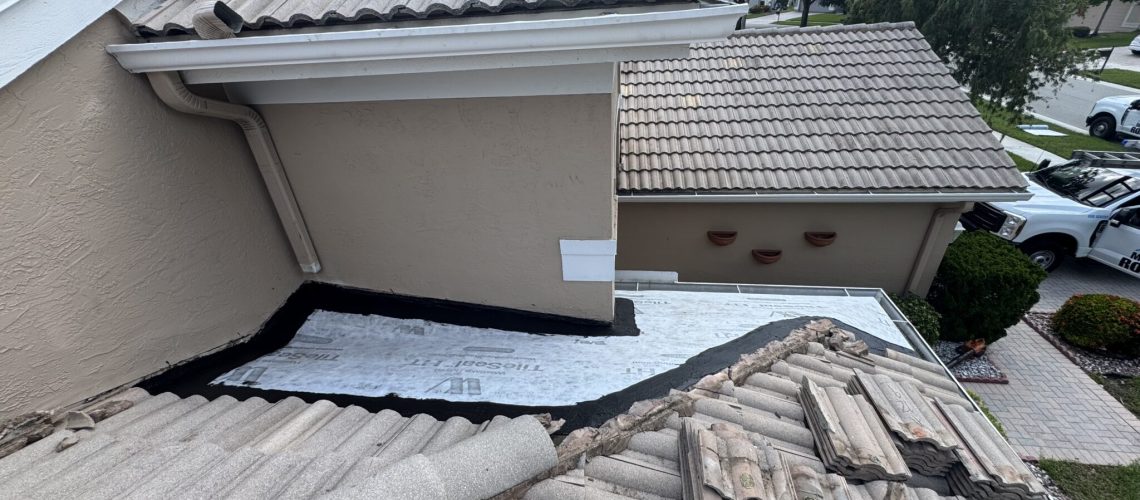
That ceiling stain is back. You patched the flat roof six months ago, paid for another repair last spring, and now water’s dripping into your commercial space or home again. If your flat roof feels like a recurring expense with no permanent solution, you’re not alone—and more importantly, you’re probably treating symptoms instead of addressing root causes.
Flat roofs across Palm Beach County face unique challenges that sloped roofs simply don’t encounter. Standing water, intense UV exposure, thermal expansion in our year-round heat, and installation shortcuts create a perfect storm for persistent leaks. The good news? Most chronic flat roof leak problems stem from identifiable, fixable issues that don’t require complete roof replacement.
The Real Culprits Behind Recurring Flat Roof Leaks
After five decades repairing commercial and residential flat roofs throughout South Florida, Mike McGilvary Roofing has identified patterns. The same problems appear repeatedly, and they’re rarely what homeowners expect.
Ponding Water: The Silent Roof Killer
Flat roofs aren’t actually flat—they should have a minimum slope of 1/4 inch per foot to facilitate drainage. When water sits on your roof for more than 48 hours after rain, you have ponding.
Ponding water causes devastating cumulative damage:
- Accelerates membrane deterioration by keeping materials constantly saturated
- Breaks down adhesives and sealants through continuous UV exposure in standing water
- Creates freeze-thaw cycles during our occasional cold snaps
- Adds weight stress to structural members not designed for permanent water load
- Promotes vegetation and algae growth that penetrates roofing membranes
Property owners often don’t see ponding because water evaporates between rainstorms. Look for circular stains, sediment rings, or algae patches—these indicate where water regularly pools. Flat roof drainage problems typically result from inadequate initial slope, sagging structural members, or clogged drainage systems.
Membrane Deterioration From UV Exposure
South Florida’s subtropical sun is relentless. Our UV index regularly reaches 10+ from March through October, and flat roofs absorb this punishment directly with no slope to deflect rays.
Common membrane materials respond differently to our climate:
- EPDM (rubber): Develops surface cracks after 15-20 years, seams separate as material shrinks
- TPO (thermoplastic): Seam failure is the primary issue; heat-welded seams can separate from thermal cycling
- Modified bitumen: Surface granules erode, exposing underlying asphalt to direct UV
- Built-up roofing (BUR): Top coating breaks down, allowing water penetration to felts below
When UV degradation begins, homeowners typically spot-repair obvious cracks or holes. This addresses individual leak points but ignores the broader membrane failure happening across the entire roof surface. It’s why your flat roof keeps leaking in different spots—the whole membrane is compromised.
Flashing Failures at Critical Transitions
Water doesn’t penetrate the middle of flat roof membranes—it finds entry at transitions, penetrations, and edges. Flashing protects these vulnerable points, but South Florida conditions test every installation:
- Parapet walls where roof meets vertical surfaces
- HVAC units, exhaust vents, and satellite dish mounts
- Drain assemblies and scuppers
- Skylights and roof hatches
- Expansion joints between roof sections
Caulks and sealants deteriorate rapidly in our heat. That bead of caulking around your HVAC unit has a realistic lifespan of 3-5 years in Palm Beach County’s climate. When it fails, water enters the roof system at the penetration—exactly where it’s hardest to trace and repair effectively.
Installation Shortcuts That Guarantee Future Problems
The flat roofing industry has a quality problem. Because flat roofs are less visible than sloped roofs, some contractors cut corners knowing homeowners won’t see the work:
- Insufficient membrane overlap at seams (should be minimum 3 inches for most systems)
- Inadequate fastener density at roof perimeters
- Poor surface preparation before membrane installation
- Skipping base flashing or termination bars at critical transitions
- Installing new membrane over existing wet insulation
These shortcuts create roofs that leak prematurely and repeatedly. You patch one area, but the fundamental installation deficiency remains, causing failures elsewhere.
Why Temporary Fixes Keep Failing
Most commercial roof repair attempts address symptoms rather than causes. A roofer comes out, finds the obvious leak point, applies sealant or patches the membrane, and leaves. The leak stops—temporarily.
Here’s why this approach fails:
Water migration: Where water enters the roof system often isn’t where it appears inside. Water can travel along roof decking, insulation layers, or structural members for 10-20 feet before finding a path through your ceiling. Patching where you see interior water damage misses the actual entry point.
System-wide deterioration: If one section of your membrane is failing, adjacent areas are experiencing similar stress. Patching the leak that’s visible today doesn’t address the section that will fail next month.
Trapped moisture: Once water enters the roof assembly, it saturates insulation and decking. Surface repairs trap this moisture inside, where it continues causing damage and will eventually find another exit point.
This explains the frustrating cycle: repair, temporary relief, new leak, another repair, repeat. You’re not fixing the roof—you’re playing whack-a-mole with leak symptoms.
How to Actually Fix a Chronically Leaking Flat Roof
Permanent flat roof leak repair requires identifying root causes and addressing the entire system, not individual leak points. This doesn’t always mean complete replacement, but it does mean strategic intervention.
Comprehensive Roof Inspection and Moisture Survey
Effective repair starts with understanding what’s actually happening. Mike McGilvary personally inspects every roof, looking beyond obvious damage:
- Core sampling to assess membrane, insulation, and decking condition
- Infrared moisture scanning to identify trapped water
- Drainage evaluation including slope measurements
- Structural assessment for sagging or deflection
- Complete penetration and flashing inspection
This inspection often reveals that 30-40% of the roof surface remains sound while specific areas need replacement. That’s valuable information that saves thousands compared to full replacement.
The Roof Rebuild Approach for Flat Roofs
You don’t buy a new car when you hit 30,000 miles—you replace the tires, change the oil, and address what actually needs attention. Your flat roof works the same way.
A strategic flat roof rebuild might include:
- Complete membrane replacement in sections with trapped moisture or deterioration
- Insulation replacement only where saturated (dry insulation stays)
- Decking repair at specific damaged areas rather than wholesale replacement
- Drainage improvements including tapered insulation to eliminate ponding
- Complete flashing reconstruction at all penetrations and transitions
- New coating system over sound membrane sections to extend lifespan
This approach costs 40-60% less than complete replacement while solving the actual problems causing your recurring leaks. For a typical 2,000 square foot commercial flat roof, you might invest $8,000-$15,000 in a strategic rebuild versus $25,000-$40,000 for complete replacement.
Addressing Drainage and Ponding Permanently
If flat roof drainage problems contribute to your leaks, repairs must include drainage solutions:
Tapered insulation systems: Engineered insulation panels create positive slope to existing drains, eliminating ponding areas without structural modifications. Cost typically runs $3-$5 per square foot installed.
Additional drain installation: Adding drains in chronic ponding areas provides new exit paths for water. Expect $800-$1,500 per drain including penetration flashing and interior connection.
Cricket and saddle construction: Small sloped structures divert water away from HVAC units and other large penetrations where ponding commonly occurs.
Scupper upgrades: Enlarging or adding scuppers (wall openings for drainage) provides emergency overflow capacity during heavy rain events.
Preventive Flat Roof Maintenance
Once your flat roof is properly repaired, maintenance extends its lifespan and prevents new leaks:
- Quarterly drain and gutter cleaning (critical in South Florida)
- Semi-annual roof inspections checking flashing, seams, and membrane condition
- Immediate penetration resealing when caulk shows deterioration
- Debris removal after storms (branches, leaves trap moisture)
- Recoating every 5-7 years to protect membrane from UV
Mike McGilvary Roofing offers flat roof maintenance programs for commercial properties throughout Palm Beach County. Regular attention costs $400-$800 annually but prevents the $3,000-$8,000 emergency repairs that result from neglect.
When Complete Replacement Actually Makes Sense
Honesty matters. Sometimes flat roofs genuinely need complete replacement rather than repair:
- Moisture surveys show saturation across more than 60% of roof area
- Structural members show rot or significant deflection
- The roof has exceeded its realistic lifespan (25+ years for most systems)
- Building use is changing, requiring upgraded insulation or different membrane type
- Multiple repair attempts have failed to solve chronic leaking
Even in replacement scenarios, Mike McGilvary provides honest assessments. A Boca Raton commercial property owner recently received quotes for $45,000 full replacement from three contractors. Mike’s inspection revealed that 70% of the modified bitumen membrane remained sound—only the problematic north section needed replacement. Strategic repair cost $14,000 and came with a 5-year certification for the owner’s insurance requirements.
Insurance Considerations for Flat Roof Repairs
Florida’s property insurance crisis affects flat roof owners significantly. Many carriers now require commercial roofs under 20 years for coverage, and residential flat roofs face similar scrutiny.
Strategic repairs can satisfy insurance requirements:
- Documented repairs with proper permits “reset” roof age for some carriers
- 5-year roof certifications confirm the roof is insurable-grade
- Complete repair documentation supports insurance claims for future storm damage
- Proactive maintenance records demonstrate responsible property management
Mike McGilvary Roofing provides free roof inspections and 5-year certifications. For property owners facing coverage non-renewal due to roof age, a $12,000 strategic rebuild with certification beats a $35,000 replacement every time.
Stop the Leak Cycle With Honest Assessment
Your flat roof keeps leaking because someone keeps treating symptoms instead of diagnosing the disease. Ponding water, membrane deterioration, flashing failures, or installation deficiencies won’t fix themselves with another tube of caulk.
Mike McGilvary Roofing has served Palm Beach County (a McGilvary family legacy of licensed roofing dating to 1974) with a simple philosophy: tell homeowners and business owners what they actually need, not what generates the biggest invoice. Mike personally inspects every roof and provides transparent options—from targeted repairs to strategic rebuilds to complete replacement when genuinely necessary.
Licensed (CCC1331721), BBB A+ rated, and backed by hundreds of five-star Google reviews, we’re available 24/7 for emergency leak response throughout Boca Raton, West Palm Beach, Delray Beach, and surrounding communities.
That recurring leak is telling you something. Let’s find out what it’s actually saying and fix it permanently. Contact Mike McGilvary Roofing today for an honest flat roof inspection and repair options that make sense for your property and budget.
Related from Mike McGilvary Roofing